|
Getting your Trinity Audio player ready...
|
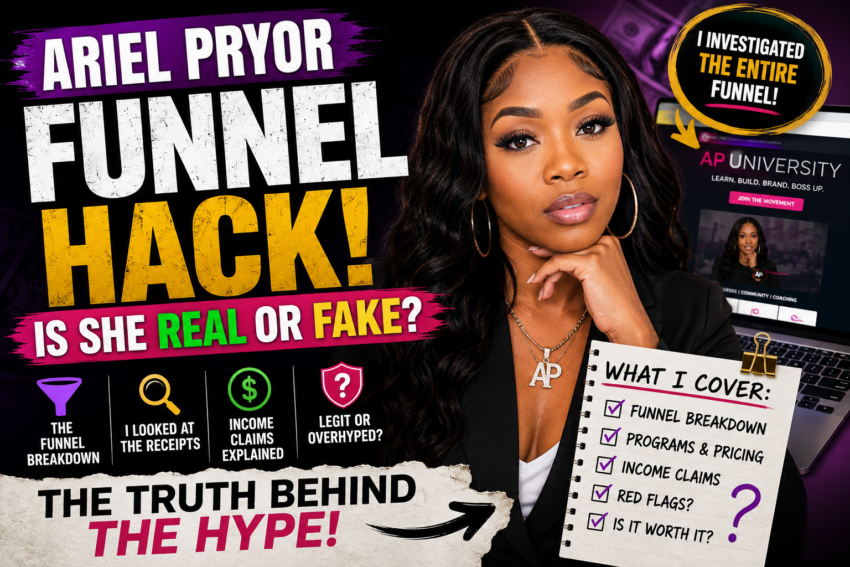
Ariel Pryor Funnel Hack: Is She Real or Fake? I Looked at the Receipts
You’ve probably seen the marketing, the income claims and the business-building promises. But what happens when we look past the funnel and examine what’s actually being offered?
▶ Watch My Investigation See the Receipts ↓
Let’s talk about something I think we need to do a lot more often online:
Separate a good marketing funnel from proof that the opportunity being marketed will actually produce the results you expect.
Ariel Pryor has built a visible online marketing operation around entrepreneurship, personal branding, digital marketing and business education.
So the question isn’t simply, “Is Ariel Pryor a real person?”
Obviously, there is a real business operation and real programs being marketed.
The more useful questions are:
- What exactly is she selling?
- How does the funnel work?
- What claims are being made?
- Which claims can we independently verify?
- What should you investigate before spending your money?
⚠️ Before We Get Into This
This article is an independent analysis of publicly available marketing materials. Calling someone’s marketing aggressive, examining income claims, or questioning whether a program is worth its price is not the same as proving fraud. Nothing I found establishes that Ariel Pryor is “fake” or operating a scam. Where income figures appear below, I identify them as claims unless independently verified.
🎥 Watch: Ariel Pryor Funnel Hack — Is She Real or Fake?
Watch my full breakdown below, then keep reading because we’re going to look at the actual funnel.
🧾 Receipt #1: There Is a Real Marketing Operation
The first thing I wanted to establish was whether there was an actual business ecosystem behind the marketing.
There is.
Ariel Pryor’s current program terms identify Ariel Pryor, AP University and the Build A Boss Program as services offered through her websites.
There is also a private marketing community currently listed on Skool under Ariel Pryor. The listing advertises marketing training, monthly mastery calls, social-media strategies, content training, vendor information and other entrepreneurial resources.
So is there a real program?
Yes. There is a publicly visible business, training ecosystem and paid community. That’s different from saying every marketing claim has been independently verified or that every buyer will get the results advertised.
This Is the Funnel
Content → Free Training → Trust → Paid Community/Program → Additional Offers
🧾 Receipt #2: Look at the Funnel, Not Just the Product
This is where the marketing gets interesting.
A funnel doesn’t necessarily start by asking you for thousands of dollars.
It often starts with something easy to say yes to.
One of Ariel’s public Build A Boss pages advertised a free Digital Builder Summit.
The page then positions Ariel as a mentor and describes her as a “7-Figure Entrepreneur” and “Brand Monetization Expert.”
That’s classic funnel strategy:
STEP 1: Get attention with social content.
STEP 2: Offer free training.
STEP 3: Establish credibility through personal success stories.
STEP 4: Teach enough to demonstrate expertise.
STEP 5: Introduce the paid solution.
STEP 6: Move interested customers deeper into the business ecosystem.
And I want to be clear: using a funnel is not suspicious by itself. That’s marketing.
The important question is whether the paid offer provides value that justifies the price and whether the claims used to sell it are properly supported.
🧾 Receipt #3: Pay Attention to the Income Claims
This is where I want you to slow down.
On the Build A Boss promotional page, Ariel’s marketing says she made her first $100,000 as a hairstylist by age 16, opened her first salon at 18, made $700,000 in one year selling digital products and coaching by age 20, and had built a seven-figure brand by 22.
Here’s the important distinction:
Those numbers appear on Ariel’s own marketing pages.
I did not find independent financial records in my research that would allow me to verify those exact figures. That does NOT prove they’re false. It simply means you should treat them as self-reported marketing claims rather than independently verified earnings.
An Income Claim Is Not the Same as Independent Verification
Always ask: Who is making the claim, and what evidence supports it?
🧾 Receipt #4: The Paid Community Is Publicly Listed
I also found Ariel’s current private marketing community listed publicly through Skool.
At the time I checked, it advertised a $37-per-month membership and listed benefits including monthly calls, social-media strategies, vendor lists, viral content strategies, personal-development training and accountability.
The page also uses urgency:
It says the $37 price is time-sensitive and warns that the price will increase.
Again, urgency is a normal marketing technique.
But whenever urgency is used, don’t let a countdown, deadline or “price going up” message replace your own due diligence.
🔥 The Funnel Hack: Why This Marketing Works
This is actually the part entrepreneurs can learn from whether they ever purchase one of Ariel’s products or not.
Lead with transformation, income or a strong business outcome.
Show where you started and where you are now.
Give prospects a low-risk way to enter your world.
Use results and positioning to establish expertise.
Give customers an environment where they can stay engaged.
Give the prospect a reason to make a decision now.
The Biggest Lesson: Don’t Confuse Marketing Skill With Your Expected Results
Someone can be an excellent marketer.
They can have a beautiful funnel.
They can have followers.
They can have testimonials.
They can have screenshots.
And none of those things automatically tell you what your results will be.
Buying access to somebody else’s strategy does not automatically transfer their results to you.
💻 Want to Learn How Online Funnels Actually Work?
I review online-business platforms, affiliate marketing tools and software here on Success With Trecia so you can understand the systems behind online marketing—not just the income screenshots.
See My Systeme.io Review →Questions I Would Ask Before Buying ANY Coaching Program
❓ What exactly am I getting?
❓ Is the training live, prerecorded or both?
❓ How much direct access do I actually get to the person advertising the program?
❓ What is the complete cost?
❓ Are there additional upsells?
❓ What is the refund policy?
❓ Are earnings claims typical or exceptional?
❓ Can I independently verify testimonials?
❓ What work will I personally have to do?
❓ Can I realistically afford to lose the entire purchase price if the program doesn’t work for me?
🚩 Red Flags to Watch for With ANY Online Guru
These aren’t accusations about Ariel specifically. These are things I recommend watching for whenever you’re considering an online business program.
- Guaranteed income
- Pressure to purchase immediately
- Unclear refund policies
- Income screenshots without context
- Testimonials that can’t be verified
- Constant upsells you weren’t told about upfront
- Vague descriptions of what you’re actually buying
- Claims that the business requires little or no work
- Pressure to take on debt to purchase coaching
🤖 Building an Online Business on a Smaller Budget?
You don’t necessarily need expensive coaching just to start learning. I’ve also reviewed free and lower-cost AI and online-business tools.
Explore More Success With Trecia Reviews →So… Is Ariel Pryor Real or Fake?
Based on what I found:
REAL: There is a real business operation, public training pages, terms, programs and a paid community.
REAL: There is an identifiable marketing funnel behind the brand.
NOT ESTABLISHED BY MY RESEARCH: I did not independently verify the exact personal income figures advertised on her promotional pages.
NOT SOMETHING I CAN FAIRLY CLAIM: I found no basis from this research to label Ariel Pryor a scammer or “fake.”
So I think the better question is:
Is what she’s selling worth the price for YOU?
And that’s a decision you should make based on the actual curriculum, access, price, refund terms and realistic expectations—not somebody else’s income claim.
Frequently Asked Questions
Who is Ariel Pryor?
Ariel Pryor is an entrepreneur and online marketer who sells business, branding and digital-marketing education through programs and communities including AP University and Build A Boss.
Is Ariel Pryor’s program real?
There are publicly accessible program websites, terms and a paid Skool community connected to Ariel Pryor. Whether a particular program is worth purchasing depends on its current curriculum, price, support and your goals.
Is Ariel Pryor a scam?
I did not find evidence sufficient to responsibly make that accusation. Consumers should independently investigate any coaching program before buying and distinguish self-reported marketing claims from independently verified results.
How does Ariel Pryor’s funnel work?
Publicly visible funnels use common digital-marketing techniques including social content, free training, personal success stories, authority positioning, community offers and urgency.
Are Ariel Pryor’s income claims verified?
The income figures discussed in this article appear on her own promotional pages. I did not locate independent financial documentation confirming the exact amounts during my research.
Final Thoughts
There’s actually something bigger to learn from this than whether you personally like Ariel Pryor.
Study the marketing.
Look at how the funnel gets your attention.
Look at how the free offer builds trust.
Look at how the personal story establishes authority.
Look at how the paid offer is introduced.
And then separate all of that from the question:
“What evidence do I have that this purchase makes financial sense for ME?”
That’s how I want you looking at every online guru—not emotionally, but critically.
Want More Online Guru & Money-Making Reviews?
I break down online business opportunities, AI tools, affiliate programs, software and money-making claims so you can see what’s really behind the marketing.
▶ Watch My Ariel Pryor Breakdown Explore Success With Trecia →