

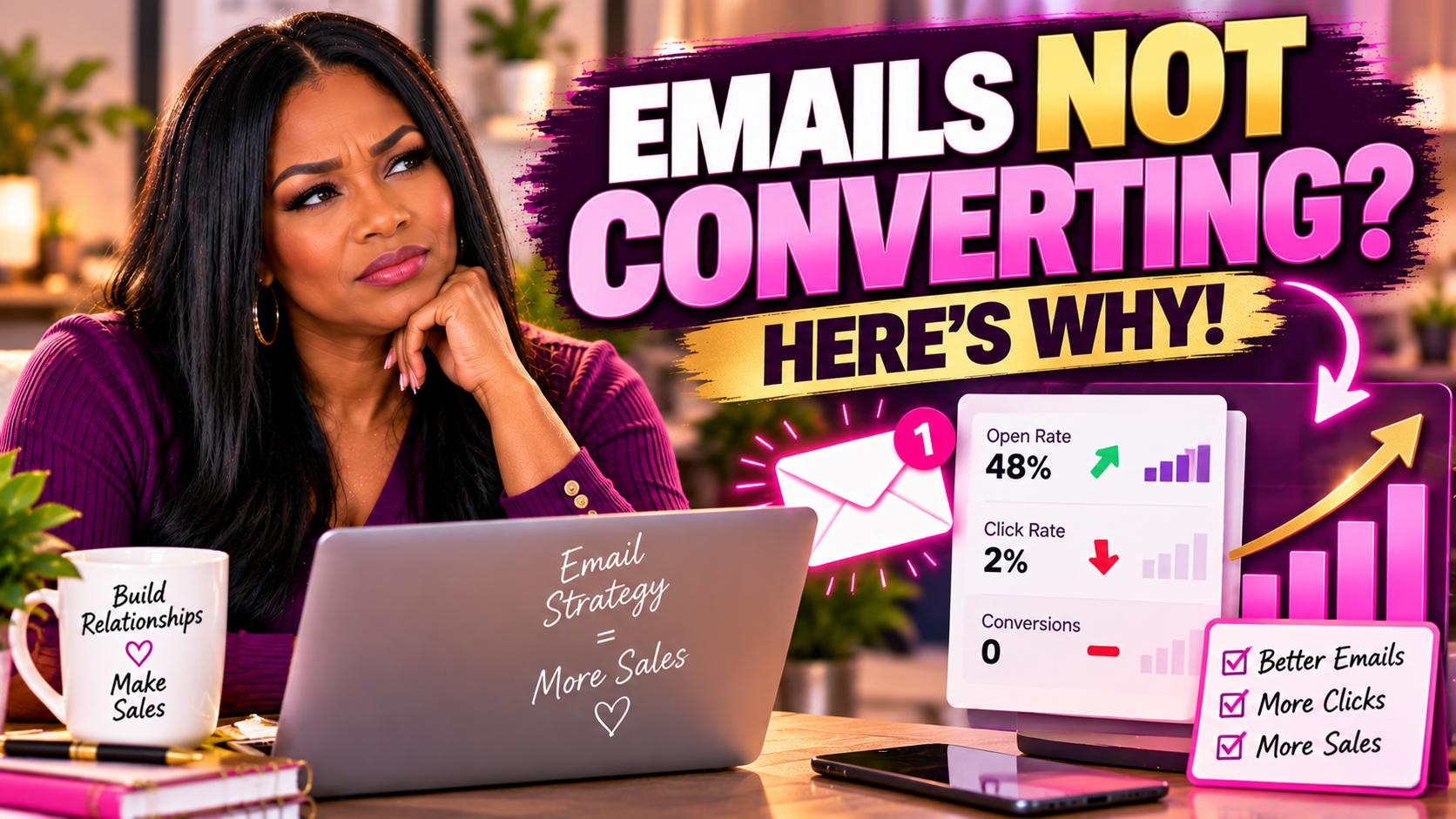
Why Your Affiliate Marketing Emails Aren’t Converting (And How to Fix It)
People are joining your email list, but nobody’s clicking your links or buying? Let’s look at what might be going wrong and how to improve your emails without sounding like a pushy salesperson.
You spent time creating your website. You made a free guide. You collected email addresses. You even started sending messages to your subscribers.
But there’s just one little problem.
Nobody seems to be buying anything.
And now you’re wondering whether email marketing actually works for affiliate marketers.
Well, before you give up, let me tell you something: having an email list and knowing how to communicate with that list are two different things.
Sometimes the problem isn’t the affiliate product. It’s what happens between the moment someone subscribes and the moment you ask them to click your link.
Let’s break down the mistakes that may be hurting your conversions and what you can do differently.
Watch My Video: Why Your Affiliate Marketing Emails Aren’t Converting
In this article, we’ll go deeper into the relationship between your subject lines, subscriber expectations, email content, affiliate recommendations, and follow-up strategy.

First, What Does It Mean When an Affiliate Email Converts?
A conversion happens when somebody takes the action you’re trying to encourage.
Depending on your goal, that might mean:
- Clicking a link in your email
- Visiting an affiliate product page
- Signing up for a free trial
- Registering for a webinar
- Making a qualifying purchase
These actions aren’t all the same thing.
Someone clicking your affiliate link doesn’t automatically mean you’ve earned a commission.
And somebody opening your email doesn’t necessarily mean they’re interested in what you’re selling.
That’s why you need to understand exactly where people are losing interest.
If subscribers aren’t opening, examine your subject lines and inbox placement. If they’re opening but not clicking, examine your content and offer. If they’re clicking but not buying, investigate the landing page, product fit, and purchase process.
1. You’re Trying to Sell Before You’ve Built Any Trust
Imagine meeting somebody for the first time, and before they even learn your name, you start asking them to buy something.
Wouldn’t that feel a little strange?
Well, that’s exactly what some affiliate marketers do with their email lists.
Somebody downloads a free guide, and suddenly every email is:
- “Buy this product!”
- “Don’t miss this offer!”
- “This is your last chance!”
- “Click here before it’s too late!”
Now, there’s nothing wrong with making an offer.
But your subscribers need a reason to trust your recommendations.
How to Fix It
Start by delivering what you promised when they signed up.
Then share helpful information related to their interests.
For example, if somebody downloads your free affiliate marketing guide, your next email could explain three beginner mistakes that waste money.
Another email could walk them through choosing a website niche.
Then, when you recommend an affiliate marketing tool or training platform, your recommendation fits naturally into the conversation.
You’re helping them solve a problem instead of simply asking them to spend money.
2. Your Subject Lines Aren’t Giving People a Reason to Open
Let’s talk about subject lines.
You can write the most helpful email in the world, but if nobody opens it, they won’t see your message.
And sometimes the problem starts with a subject line that’s either too boring or too exaggerated.
| Less Effective Subject Line | More Specific Alternative |
|---|---|
| Important Information | 3 Mistakes I See New Affiliate Marketers Make |
| Check This Out! | Before You Pay for Another Marketing Tool… |
| Make Money Fast! | What I Would Learn Before Starting Affiliate Marketing |
| My Favorite Product | What to Look for in an Email Marketing Platform |
Notice the difference?
The second group tells subscribers what they’re going to learn.
Try writing subject lines that are clear, relevant, and interesting without misleading people.
Avoid fake urgency and promises you can’t support.
3. You’re Promoting Products That Don’t Match Your Audience
This mistake can cost you clicks and sales.
Let’s say somebody joins your email list because they want to learn how to start affiliate marketing on a small budget.
But your next email promotes an expensive business program they can’t afford.
That offer might not match what they need right now.
Or imagine somebody signs up for website traffic tips, and you immediately send them unrelated product promotions.
They may wonder why they subscribed in the first place.
How to Fix It
Think about the problem your subscriber was trying to solve when they joined your list.
Then recommend products that genuinely relate to that problem.
New Affiliate Marketers
Helpful content about niche selection, websites, content creation, and beginner-friendly tools.
Website Owners
Guidance on SEO, site performance, email capture, and traffic measurement.
Content Creators
Resources for creating videos, blog posts, newsletters, and useful digital products.
Email Marketing Beginners
Help with signup forms, lead magnets, welcome emails, automation, and subscriber management.
You don’t need to recommend every affiliate product available.
You need to recommend relevant products to people who may actually benefit from them.
4. Your Emails Are Too Focused on the Product
Here’s something worth remembering.
People usually aren’t interested in a long list of software features just because those features exist.
They want to know how the product might help them.
For example, instead of saying:
“This email marketing platform includes signup forms, automations, templates, and subscriber management.”
Try explaining the problem first:
“If you’re manually sending your free guide to every new subscriber, you may be spending time on a task that could be automated. An email marketing platform can help deliver your guide and send follow-up messages.”
Now the reader understands why the features might matter.
But be accurate. Don’t promise that buying software will automatically increase their income or conversions.
5. You Don’t Have a Clear Call to Action
Some emails include several different links and ask the reader to do too many things.
Read this blog post.
Watch this video.
Check out three products.
Follow me on social media.
And don’t forget to buy something!
That’s a lot to ask in one message.
When appropriate, focus your email on one main next step.
If your email teaches readers how to automate a welcome sequence, the next step could be: “Explore an email marketing platform that supports automated follow-ups.”
Your call to action should connect directly to the topic of your email.
6. You’re Not Following Up With New Subscribers
This is a big one.
Someone downloads your free guide, and you send one welcome email.
Then nothing.
Three weeks later, you send them an affiliate offer.
By that time, they may not remember who you are or why they’re on your list.
That’s one reason an automated welcome sequence can be useful.

A Simple Four-Email Affiliate Marketing Sequence
You don’t need a complicated funnel to begin. Here’s a sample structure you can adapt to your audience.
Email 1: Deliver What You Promised
Suggested timing: Immediately after signup.
Send the free resource, introduce yourself, and explain what subscribers can expect from you.
Email 2: Solve One Problem
Suggested timing: Around two days later.
Share a practical tip related to the free resource. Help subscribers make progress before asking for a purchase.
Email 3: Explain a Useful Tool
Suggested timing: Around four days after signup.
Discuss a common challenge and explain how a relevant product or service could help. Include limitations and alternatives when appropriate.
Email 4: Invite the Next Step
Suggested timing: Around six days after signup.
Offer a relevant tutorial, comparison, or product recommendation with a clear call to action.
These timings are examples, not universal rules. Adjust your sequence based on subscriber expectations, engagement, and the complexity of your offer.
7. Your Emails Might Not Be Reaching the Inbox
Sometimes your content isn’t the main problem.
Your messages may be getting filtered into spam or promotions folders, or failing to reach subscribers at all.
Several factors can affect inbox placement, including:
- Domain authentication
- Sender reputation
- Spam complaints
- Inactive or invalid addresses
- Sending frequency
- Whether subscribers recognize and engage with your emails
When using your own domain with AWeber, review your domain authentication settings, including DKIM and DMARC.
You can read AWeber’s official domain authentication instructions.
Also make sure subscribers have agreed to receive your marketing messages, and give them an easy way to unsubscribe.
Don’t assume that sending more emails will solve a deliverability problem.
8. You’re Not Measuring the Right Numbers
Let’s say you send an email to 500 subscribers.
Twenty people click your affiliate link, but nobody makes a purchase.
Does that mean the email failed?
Not necessarily.
It tells you that some subscribers were interested enough to click, but something else may have prevented a purchase.
Maybe the offer was too expensive.
Maybe the landing page wasn’t convincing.
Maybe the product wasn’t the right fit.
Or perhaps the purchase decision simply takes more time.
Important Metrics to Track
| Metric | What It Helps You Understand |
|---|---|
| Delivery and bounce rates | Whether messages are reaching valid mailboxes |
| Open rate | A directional engagement signal, though privacy features can distort it |
| Click-through rate | Whether readers take action on your links |
| Unsubscribe rate | Whether content or frequency may be mismatched with expectations |
| Affiliate conversions | Whether qualifying actions happen after a click |
| Net commissions | What you actually earn after reversals and applicable costs |
Use your email marketing reports alongside your affiliate program’s reporting tools.
And remember: a high open rate alone doesn’t mean your email campaign is profitable.
9. Here’s How I Would Rewrite a Weak Affiliate Email
Let’s compare a generic sales email with one that starts by helping the reader.
Subject: Buy This Email Marketing Software Today!
Hi!
You need this amazing email marketing software. It has lots of features and can help you make money online.
Click here and sign up now!
That message doesn’t explain why the subscriber needs the product, what problem it solves, or why they should trust the recommendation.
Subject: Still Sending Your Free Guide Manually?
Hi there,
When somebody signs up for your free guide, they shouldn’t have to wait for you to check your inbox before receiving it.
One way to simplify the process is to use an email marketing platform that can deliver the resource automatically.
You can also create follow-up messages that help subscribers learn more about your topic over time.
AWeber is one option worth exploring if you’re comparing tools for signup forms and automated email sequences.
Take a look at AWeber and see whether its features and pricing fit your needs.
Talk soon,
Trecia
Disclosure: I may earn a commission if you sign up through my affiliate link, at no additional cost to you.
The second email gives readers context, explains a specific problem, and makes a relevant recommendation without promising results.
10. How AWeber Can Help You Organize Your Email Marketing
If you’re building an affiliate marketing business, having an email marketing platform can make it easier to manage subscribers and follow-up messages.
AWeber provides tools for activities such as:
- Creating email signup forms
- Building landing pages
- Sending newsletters
- Setting up automated email campaigns
- Organizing subscribers
- Reviewing email engagement reports
Those tools can help you organize your marketing workflow, but they don’t replace the need for useful content, relevant offers, and an engaged audience.
Before choosing any platform, compare its current pricing, feature limits, and available integrations.
Ready to Build a Better Email Sequence?
Explore AWeber’s email marketing tools, including signup forms, newsletters, and automated follow-up campaigns.
Compare the available features and decide whether they’re a good fit for your website and subscribers.
Explore AWeber →Affiliate link • Features and pricing may change
My Email Conversion Checklist
- Make sure subscribers know what they signed up to receive.
- Deliver the promised lead magnet promptly.
- Write clear subject lines that match the email content.
- Use helpful content before introducing relevant offers.
- Explain why the product may solve a specific problem.
- Include one clear primary call to action.
- Disclose affiliate relationships clearly.
- Test every email and affiliate link before sending.
- Check your sending-domain authentication.
- Review engagement, clicks, and actual conversions.
Frequently Asked Questions
Why are people opening my affiliate emails but not clicking?
Your message may not clearly explain the benefit of clicking, the offer may not match the audience, or the call to action may be difficult to find. Try testing one element at a time.
How many emails should be in an affiliate marketing sequence?
There’s no universal number. A four-email welcome sequence can be a manageable starting point, but the appropriate length depends on your audience and what they expect to receive.
Should every email include an affiliate link?
No. Emails can educate, answer questions, and build trust without promoting a product every time. Recommendations should be relevant and appropriately disclosed.
Can AWeber automatically send affiliate marketing emails?
AWeber supports automated email campaigns. You must still follow its current acceptable-use policies, the rules of your affiliate programs, and applicable email marketing laws.
Why are my affiliate emails going to spam?
Possible causes include poor subscriber engagement, sender reputation issues, authentication problems, or sending to people who didn’t request your emails. Review your email service’s deliverability guidance and your list practices.
How long does it take to see conversions?
There is no guaranteed timeline. Results depend on your audience, product, offer, traffic quality, message content, and many other factors.
Final Thoughts: Stop Sending Emails Just to Sell Something
If your affiliate marketing emails aren’t converting, don’t automatically assume email marketing doesn’t work.
Look at the whole process.
Why did somebody join your list?
What did you promise them?
Are your messages actually helping them?
And does the product you’re recommending make sense for their situation?
Sometimes improving your results isn’t about sending more emails.
It’s about sending more useful emails.
Build trust, explain the value, make relevant recommendations, and pay attention to what your subscribers are telling you through their actions.
That’s how you start building a more thoughtful email marketing strategy instead of constantly chasing the next sale.
For more online business and affiliate marketing tips, visit Success with Trecia.
This article is for educational purposes. Email engagement and affiliate income are not guaranteed. Results vary by audience, offer, marketing practices, and other factors.