
|
Getting your Trinity Audio player ready...
|
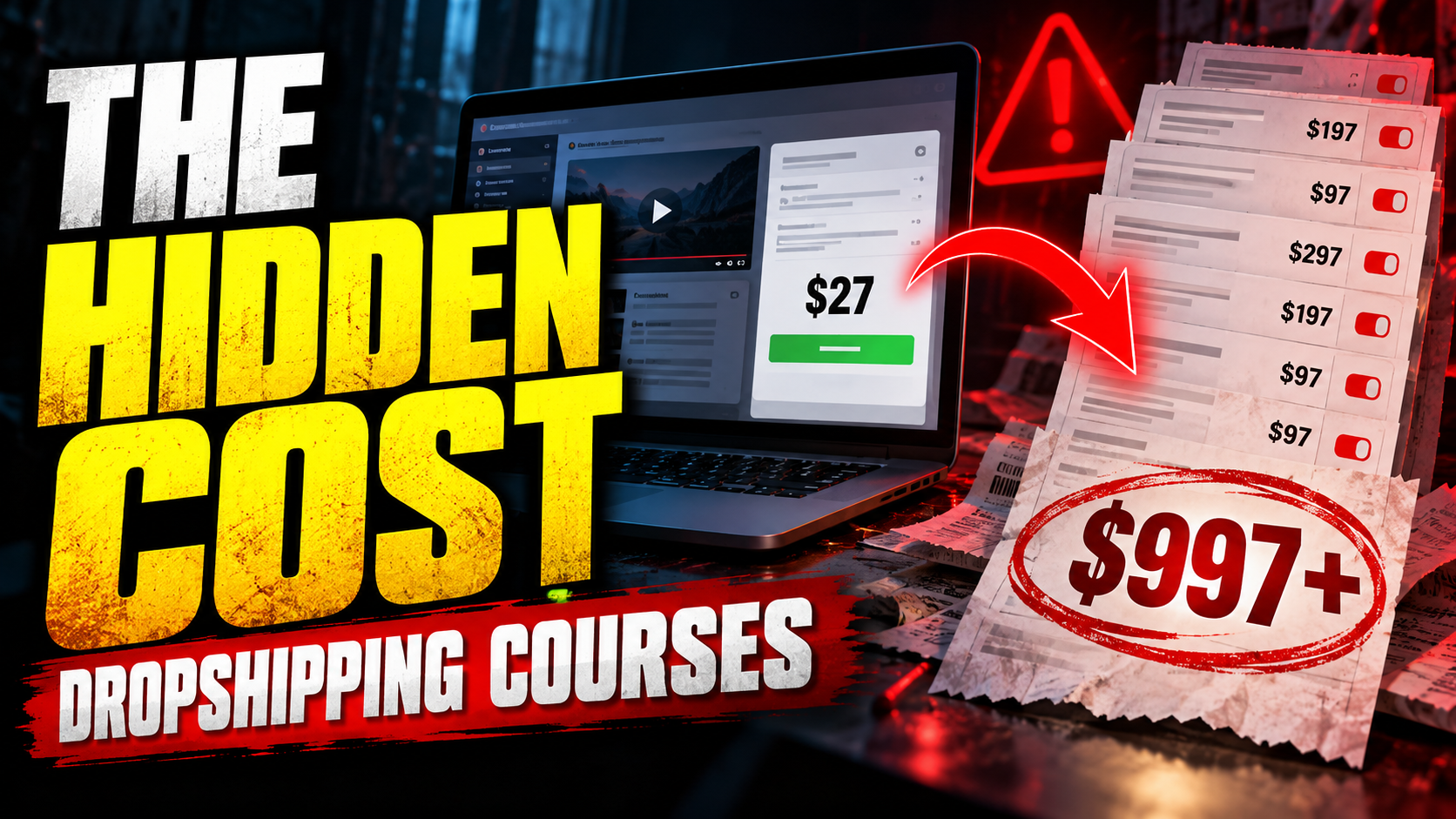
The Hidden Cost of Dropshipping Courses
A $27 training offer can sound harmless—until the software, upgrades, coaching, advertising, product testing, and operating expenses begin stacking up. Here is how to calculate the real price before you buy.
The Course Price Is Not the Business Price
The first payment may buy information, but it usually does not build or operate the store for you. A responsible budget must include both the cost of learning and the cost of actually testing the business model.
That does not mean every dropshipping course is a scam. It means a cheap entry price should never be mistaken for the total investment required to create a functioning ecommerce business.
Watch: The Hidden Cost of Dropshipping Courses
Dropshipping is a real fulfillment model. You sell an item through your store, send the order to a supplier, and the supplier ships it to the customer.
What gets oversimplified is everything surrounding that transaction: customer acquisition, software, returns, supplier reliability, cash flow, taxes, and customer service.
Shopify’s current guide estimates that a lean dropshipping setup can require approximately $200 to $600 per month , depending on the platform, tools, and marketing choices. That estimate is separate from whatever you paid for a course.

How the Low-Priced Course Funnel Works
The inexpensive course is sometimes called a front-end offer. Its job is to get you inside the sales funnel. Once you have paid, you may encounter additional offers.
- The starter course: A low-priced introduction that explains the general business model.
- The template or toolkit: Product lists, store themes, supplier directories, prompts, or research tools.
- The software subscription: Product-importing, fulfillment, analytics, email, or automation services.
- The advanced program: Additional modules said to contain the strategy needed to scale.
- Group coaching: Calls, communities, or accountability programs sold separately.
- Private coaching or done-for-you services: The highest-priced offer in the funnel.
Each upgrade may be described as optional. But if the sales presentation makes the starter course feel incomplete without those upgrades, the $27 decision was never really a $27 decision.
The Pressure Tactic to Watch
Be cautious when a seller suggests that hesitation means you are afraid of success, have a poor mindset, or do not believe in yourself.
Asking questions about a business expense is not negativity. It is basic due diligence.
The Costs the Sales Video May Barely Mention
1. Store Platform and Domain
You may need an ecommerce platform, a domain, business email, and possibly a paid theme. Introductory prices can expire, so calculate the standard renewal price instead of budgeting only for the first month.
2. Apps and Automation
Dropshipping stores often use apps for supplier connections, product importing, order routing, reviews, email marketing, abandoned carts, currency conversion, and analytics.
A collection of small monthly subscriptions can quietly become one of the largest recurring expenses.
3. Product Samples
If you never order the product, you may not know what your customer will receive. Samples allow you to check packaging, shipping speed, product quality, instructions, and whether the supplier’s photographs match reality.
4. Advertising and Content
A store without visitors is only a website. Paid advertising can consume money before you discover whether the product, offer, advertisement, or landing page converts.
Organic content can reduce your dependence on advertising, but it requires consistent time, testing, and production.
5. Order-Processing Cash Flow
A customer’s payment may not reach your bank immediately. Meanwhile, the supplier may require payment before shipping the order.
New sellers may therefore need enough working capital to process orders while customer funds are pending or being held in reserve.
6. Refunds, Returns, and Chargebacks
Customers contact your store—not the course creator—when an item arrives late, damaged, different from its description, or not at all.
Refunds, replacement shipments, chargeback fees, and return costs can erase the profit from several successful orders.
7. Payment-Processing and Transaction Fees
The sale price is not the amount you keep. Payment processors and ecommerce platforms may charge transaction fees, currency-conversion costs, or additional expenses.
Review the current pricing for your country, ecommerce platform, and payment setup.
8. Business and Compliance Expenses
Depending on where and how you operate, you may need business registration, bookkeeping, tax help, licenses, privacy documents, or legal advice.
Do not take legal or tax instructions from a course sales page without independently verifying them.

A Hypothetical First-Month Budget
The amounts below are examples—not promises or universal price estimates. Your expenses could be lower or significantly higher.
| Expense | Illustrative Amount | Question to Ask |
|---|---|---|
| Introductory course | $27 | Is the complete curriculum included? |
| Upsell or coaching | $197–$997+ | What can I accomplish without upgrading? |
| Store and domain | $45–$75 | What will renewal cost? |
| Apps and tools | $30–$150 | Which tools are truly required? |
| Product samples | $40–$200 | Can I verify product quality first? |
| Initial advertising test | $150–$500+ | Can I afford to lose the testing budget? |
| Refund and cash-flow reserve | Varies | Can I process orders before payouts clear? |
A $27 course could therefore sit at the entrance to a first-month commitment of several hundred—or several thousand—dollars.
The point is not that you must spend every amount listed above. The point is that the advertised front-end price tells you very little about the complete cost of operating the business.
Red Flags Before You Buy a Dropshipping Course
- Guaranteed income, guaranteed sales, or an exact income timeline
- Screenshots of revenue presented as proof of profit
- No clear explanation of advertising or operating expenses
- A countdown timer that repeatedly resets
- Pressure to use credit cards, financing, or money needed for household bills
- Vague refund terms or a policy hidden until checkout
- Testimonials without typical-result disclosures
- A cheap course that exists mainly to schedule a high-pressure sales call
- Claims that the system is passive, automated, or nearly risk-free
- Refusal to provide the curriculum, total costs, or instructor credentials
The Federal Trade Commission warns that dishonest business-coaching sellers may exaggerate their credentials, promise easy income, and push buyers toward increasingly expensive services.
Review the FTC’s advice on evaluating business and coaching offers before making a major purchase.
Questions to Ask Before Entering Your Card Number
- What is the total cost of every training level?
- Will I be pressured to schedule a sales call?
- Which software subscriptions are required?
- How much advertising money does the strategy realistically assume?
- Does the course teach organic traffic if I cannot afford ads?
- Are the earnings examples revenue or net profit?
- What percentage of students achieve the promoted result?
- Can the seller substantiate its earnings claims in writing?
- What exactly must happen to qualify for a refund?
- Can I learn the fundamentals for free before making this purchase?

When a Paid Course May Be Worth It
A paid course may provide value when it gives you a clear sequence, updated demonstrations, organized resources, feedback, and support that would take you much longer to assemble independently.
The value depends on the quality of the material, the instructor’s experience, the transparency of the offer, and your ability to apply what is being taught.
A course is more promising when:
- The curriculum is available before checkout.
- The instructor clearly separates revenue from profit.
- Startup and recurring costs are disclosed.
- The refund rules are specific and easy to find.
- Results are described without guarantees.
- The course is useful without purchasing another expensive tier.
- You can comfortably afford both the training and the business test.
What to Do Before Paying for Any Course
- Learn the basic dropshipping model through free, independent resources.
- Read the most common dropshipping mistakes .
- Study this step-by-step dropshipping overview .
- Calculate a complete three-month operating budget.
- Search for complaints, refund experiences, and independent reviews.
- Read every contract and refund condition before paying.
- Walk away if the decision requires high-interest debt or money needed for bills.
For an example of why revenue and profit must be separated, read my Sellvia review based on my 30-day experience .
A dashboard can display attractive sales numbers while advertising, fulfillment, reserves, fees, and withdrawals tell a very different story.
Do Not Buy the Dream—Price the Business
A course should improve your decision-making, not replace it. Calculate the complete cost, protect your household budget, and make the seller earn your trust before you buy.
Watch the VideoFrequently Asked Questions
Are All Dropshipping Courses Scams?
No. Some courses provide organized and useful education. The problem begins when sellers hide the true costs, misrepresent likely earnings, or use a low-priced course mainly to push expensive upgrades.
How Much Does It Really Cost to Start Dropshipping?
There is no universal amount. Your platform, domain, applications, product samples, marketing strategy, payment setup, country, and refund reserve all affect the total.
Build your budget using current provider prices rather than relying only on a course creator’s headline claim.
Should a Beginner Buy a Dropshipping Course?
Learn the fundamentals for free first. A paid course may make sense after you understand the model, know which knowledge gap you are paying to solve, and can afford the complete business test without borrowing expensive money.
What Is the Biggest Hidden Cost?
For many beginners, customer acquisition is the largest surprise. A polished store does not automatically receive visitors or sales.
Advertising requires testing capital, while organic marketing requires time and consistent content production.
Final Verdict
The hidden cost of a dropshipping course is not one single upsell. It is the gap between the price of information and the price of operating the business.
Before you pay, add the course, upgrades, tools, samples, advertising, fulfillment cash flow, refunds, and the value of your time.
If the numbers no longer make sense, walking away is a smart business decision.
Disclosure and disclaimer: This article is educational and does not provide legal, tax, or financial advice. Costs, platform prices, and policies can change. Examples are illustrative and do not guarantee earnings or business results. Links to outside websites are provided for additional research.