Disclosure: This article is educational and may contain affiliate links. If you purchase through certain links, I may earn a commission at no additional cost to you. No training program guarantees income.
You’ve decided to learn affiliate marketing. You start searching YouTube, and before long, somebody tells you they have a course that will teach you everything you need to know.
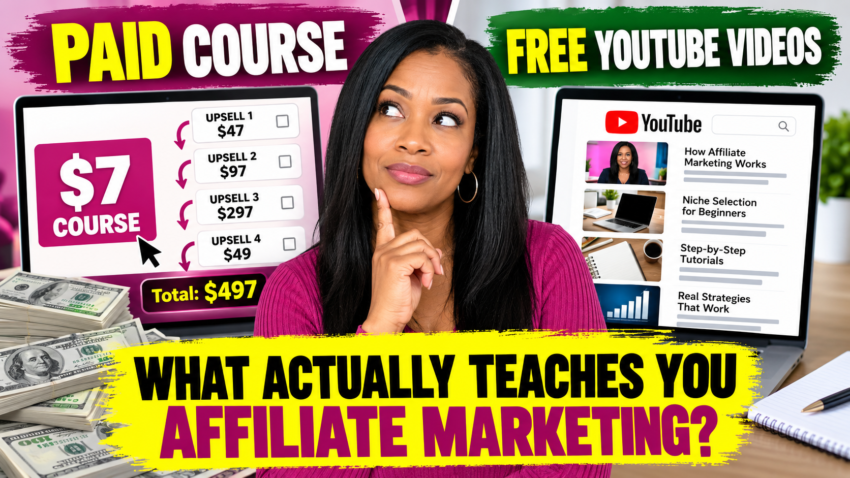
And here’s the exciting part: it’s only $7.
Seven dollars to learn how to build an online business? That sounds like a pretty good deal.
But then you get inside. Suddenly there’s a $47 upgrade, a $97 toolkit, a $297 coaching package, and maybe even a monthly membership.
Hold on. Weren’t we supposed to be learning affiliate marketing for seven dollars?
Meanwhile, another person on YouTube is explaining the same basic concepts for free.
So which one actually teaches you affiliate marketing better: a paid course or free YouTube videos, blogs, and online communities?
Let’s compare what you’re getting, what you’re really paying, and when spending money on training makes sense.
What Do You Actually Need to Learn Affiliate Marketing?
Before comparing courses, we need to understand what a beginner actually needs to learn.
Affiliate marketing is a business model where you recommend products or services and earn a commission when someone completes a qualifying purchase or action through your affiliate link.
It’s not complicated to understand. But learning to do it consistently takes practice.
A useful beginner training program should cover:
- How affiliate marketing works and how commissions are earned.
- How to choose a niche and understand your audience.
- How to evaluate legitimate affiliate programs.
- How to create helpful content that attracts potential buyers.
- How to generate traffic through search engines, social media, or other channels.
- How to use tracking links and measure results.
- How to disclose affiliate relationships and follow advertising rules.
- How to improve conversions without misleading people.
Here’s something important: none of those topics requires you to purchase an expensive course just to understand the fundamentals.
What you’re potentially paying for is the organization, feedback, support, and accountability that make learning easier.
Two Ways to Learn Affiliate Marketing
YouTube, blogs, documentation, and communities
More research and self-directionOrganized lessons, exercises, and possible support
Higher cost does not guarantee better resultsFree Affiliate Marketing Training: What Can You Actually Learn?
Let’s start with the option that makes the most financial sense for someone with a tight budget: free education.
1. YouTube tutorials
YouTube has tutorials covering affiliate networks, niche selection, keyword research, website setup, content creation, and conversion tracking.
You can watch someone demonstrate how a process works instead of simply reading about it.
But there’s a catch.
Not every YouTube creator is primarily trying to educate you. Some videos are designed to lead viewers into a paid course or software subscription.
That doesn’t automatically make the information bad. It just means you should understand the creator’s financial incentive.
My advice: Look for tutorials that demonstrate actual steps, explain limitations, and discuss realistic costs—not just income screenshots.
2. Free blogs and written guides
Blogs are especially useful when you need specific answers instead of sitting through a 45-minute video.
For example, you can research how affiliate cookies work, what attribution windows mean, or how to write an affiliate disclosure.
Start with resources such as:
- Google Search Central for guidance on creating helpful content.
- The FTC’s disclosure guidance for understanding affiliate transparency.
- YouTube for practical demonstrations and tutorials.
3. Forums and online communities
Communities can help when you’re stuck on a specific problem.
You might find discussions about affiliate program requirements, traffic strategies, website issues, and experiences with particular tools.
However, anonymous advice isn’t always reliable. Someone claiming to earn $20,000 a month may have no verifiable evidence.
Use forums to discover questions and solutions, then verify important information through official documentation.
The biggest disadvantage of free training
Free education is often scattered.
One video teaches Pinterest traffic. Another teaches blogging. Another tells you to start a YouTube channel. Then somebody says email marketing is the only strategy you need.
Before you know it, you’ve spent three weeks watching tutorials and haven’t created anything.
That’s the real weakness of free training: information overload without a structured learning plan.
Paid Affiliate Marketing Courses: What Are You Paying For?
A legitimate paid course can provide value. The question is whether it offers something useful beyond the information already available for free.
A worthwhile course might include:
- A step-by-step curriculum in a logical order.
- Practical assignments and examples.
- Updated lessons when platforms change.
- Access to an instructor for questions.
- Feedback on your website, content, or campaigns.
- A community with meaningful moderation.
- Clear pricing and refund terms.
But some courses are little more than beginner-level videos packaged behind a payment page.
If you’re paying $197 to hear someone explain what an affiliate link is, you might be purchasing convenience rather than specialized knowledge.
Convenience can have value. Just don’t confuse the price of the course with the quality of the education.
The $7 Course That Can Turn Into a $500 Purchase
Now let’s talk about the part that beginners really need to understand: the upsell funnel.
An inexpensive front-end product is sometimes called a tripwire offer. Its purpose is to make the first purchase feel easy.
After that first purchase, the seller may offer additional products.
Not every upsell is dishonest. Businesses routinely offer optional upgrades. The problem arises when the low-priced course is marketed as complete training but important lessons or support are effectively locked behind more purchases.
Here’s how a hypothetical funnel might work
Illustrative example only. These are not prices from a specific company. The $49 tool charge is treated as a one-time cost for this example; actual tools may require recurring subscriptions.
Notice what happened.
You entered the funnel expecting to spend $7. If you accepted every offer, you’d spend $497.
That’s 71 times the advertised entry price.
And if you subscribe to recurring tools or memberships, your total cost could continue growing.
Can I complete the training and apply what I’ve learned using only the original purchase, or will I need additional products to make the system work?
Why Do Affiliate Marketing Courses Have So Many Upsells?
Because the course seller is also running a business.
A low-priced product may generate relatively little profit after advertising costs, payment processing fees, and refunds.
Additional offers can increase the amount of revenue earned from each customer.
This is often described as increasing customer lifetime value.
For example, if 100 people purchase a $7 course, the seller generates $700 in gross revenue.
But if 10 of those buyers also purchase a $97 upgrade, that’s another $970 in gross revenue.
The seller’s total gross revenue becomes $1,670, before expenses or refunds.
That’s why a business may put so much emphasis on the upgrades.
The structure itself isn’t necessarily unethical. What matters is whether the seller clearly explains what’s included, whether the upgrades are genuinely optional, and whether the original product delivers its advertised value.
Paid Courses vs. Free Training: Side-by-Side Comparison
| Feature | Free Training | Paid Course |
|---|---|---|
| Upfront cost | Usually $0 | Varies widely |
| Learning structure | You organize the material | Often follows a curriculum |
| Instructor feedback | Limited or unavailable | May be included |
| Information quality | Varies by source | Also varies by provider |
| Hidden expenses | Possible software or business costs | Possible upsells and subscriptions |
| Refund protection | No course purchase to refund | Depends on written terms |
| Best for | Self-directed beginners on tight budgets | People needing structured instruction or feedback |
The biggest takeaway? Neither option automatically produces better results.
A motivated beginner using free resources can make meaningful progress. Someone who buys an expensive course but never applies the lessons may accomplish very little.
Five Pricing Questions to Ask Before Buying Any Course
- What is the full purchase price? Look beyond the first checkout page. Find out whether the seller offers required or optional upgrades.
- Are there recurring charges? Ask whether communities, software, coaching, or membership access renew automatically.
- What exactly is included? Request a lesson outline and determine which features belong to the base product.
- What is the refund policy? Check the deadline, conditions, exclusions, and cancellation instructions before purchasing.
- What other expenses will I need? Consider domains, hosting, advertising, email platforms, and other tools. A course purchase may be only one part of the total budget.
Also check whether the seller makes it easy to find the business name, customer support information, and complete terms.
If you can’t get straightforward answers before paying, that’s a reason to wait.
What I Would Do If I Had Only $50 to Learn Affiliate Marketing
If I were starting affiliate marketing with just $50, I would not rush to purchase a course.
I would first choose one traffic method and learn the fundamentals for free.
For example, I might decide to build a blog focused on a specific niche.
Then I’d research affiliate programs, study helpful-content guidelines, and publish several genuinely useful articles before considering paid training.
I would keep my $50 available for a necessary business expense or a specific learning problem I couldn’t solve on my own.
Why?
Because when money is limited, flexibility matters. Spending the entire budget on introductory information leaves nothing for actually building the business.
And no, you don’t need to buy every recommended tool immediately.
A Free 30-Day Affiliate Marketing Learning Plan
If you’re starting from zero, here’s a simple way to avoid the endless cycle of watching videos without taking action.
Learn. Build. Measure. Improve.
Week 1: Understand the business model
Learn how commissions work, what affiliate programs require, and how to identify an audience with a specific problem.
Choose one niche instead of chasing several unrelated opportunities.
Week 2: Research your audience and affiliate programs
Study what your audience is searching for and compare relevant products or services.
Read the official program terms before applying. Some programs require an established website, qualifying content, or an existing audience.
Week 3: Create your first helpful content
Choose one main platform, such as a blog or YouTube channel.
Create useful content that answers real questions. Focus on quality rather than flooding the internet with promotional links.
Week 4: Measure what you’ve accomplished
Review the content you’ve published, your audience response, and any available traffic or click data.
Identify what needs improvement and choose your next learning priority.
Important: This is a learning and implementation plan, not a promise of earning commissions in 30 days.
When Is a Paid Affiliate Marketing Course Actually Worth It?
I would consider paying for a course when three conditions are met.
First, I’ve already learned enough to understand what specific skill I’m missing.
Second, the course clearly teaches that skill and provides evidence of its curriculum, instruction quality, and support.
Third, I can afford the entire expected cost without using money needed for bills, food, or other essentials.
For example, a structured program that reviews your content and gives personalized feedback may be worth paying for if you’ve already been working on a website and need help improving it.
But paying hundreds of dollars simply because someone promises a secret shortcut? That’s not a sound buying decision.
Watch Out for These Course Pricing Tactics
- Artificial urgency: Countdown timers that repeatedly reset or deadlines that don’t appear genuine.
- Incomplete price disclosures: Important recurring charges or required tools revealed late in checkout.
- Upgrade pressure: Messages implying the basic course won’t work unless you buy the next level.
- Confusing refund terms: Refund restrictions that are difficult to locate or understand.
- Income-based pressure: Claims that buying the most expensive package is necessary to achieve financial success.
These tactics deserve scrutiny, but remember that an optional upgrade or limited-time promotion is not automatically evidence of fraud.
The key is transparency and whether the product delivers what was promised.
Frequently Asked Questions
Can I learn affiliate marketing completely free?
Yes. You can learn the fundamentals, research programs, create content, and begin practicing without buying a course. Building a particular business may still involve expenses such as hosting or software.
Are cheap affiliate marketing courses scams?
Not necessarily. Some inexpensive courses provide useful introductory training. Evaluate the curriculum, total cost, sales claims, and refund policy rather than judging only by the low price.
Is a $1,000 affiliate marketing course better than free YouTube videos?
Not automatically. A high-priced course may offer personalized instruction or support, but its price alone doesn’t prove that its lessons are more accurate or effective.
Why do some courses cost $7 and then offer expensive upgrades?
A low entry price can attract customers, while additional offers increase revenue per buyer. This can be a legitimate sales model when the offers are transparent and optional.
Should beginners buy affiliate marketing software?
Only when the software solves a clear, current need. Many beginners can learn the basics and test their approach using free tools before paying for subscriptions.
Final Verdict: Free First, Paid When It Makes Sense
Here’s where I stand.
If you’re completely new to affiliate marketing and money is tight, start with free training.
Learn the fundamentals. Choose one strategy. Create something. Make mistakes. Figure out where you’re actually struggling.
Then, if a paid course offers specific help you can’t reasonably get elsewhere, evaluate it carefully.
Don’t buy a course because you’re afraid of missing out. And don’t assume that the person charging the most money knows the most about affiliate marketing.
The best education is the education you can understand, afford, and actually put into practice.
And remember: the advertised price is only the beginning of your research. Always calculate the total cost before clicking buy.
Have you ever purchased a cheap online course only to discover a bunch of expensive upgrades afterward? Or have you learned a valuable business skill entirely from free videos?
Share your experience in the comments. Your story might help another beginner avoid an unnecessary expense.
More from Success with Trecia: Explore my other articles about online business, digital products, and making smarter decisions before investing in a new opportunity.
Disclaimer: All course prices and sales funnels used as examples are hypothetical. Affiliate marketing involves business risk, and income is not guaranteed. Review current product terms before making purchasing decisions.