
|
Getting your Trinity Audio player ready...
|
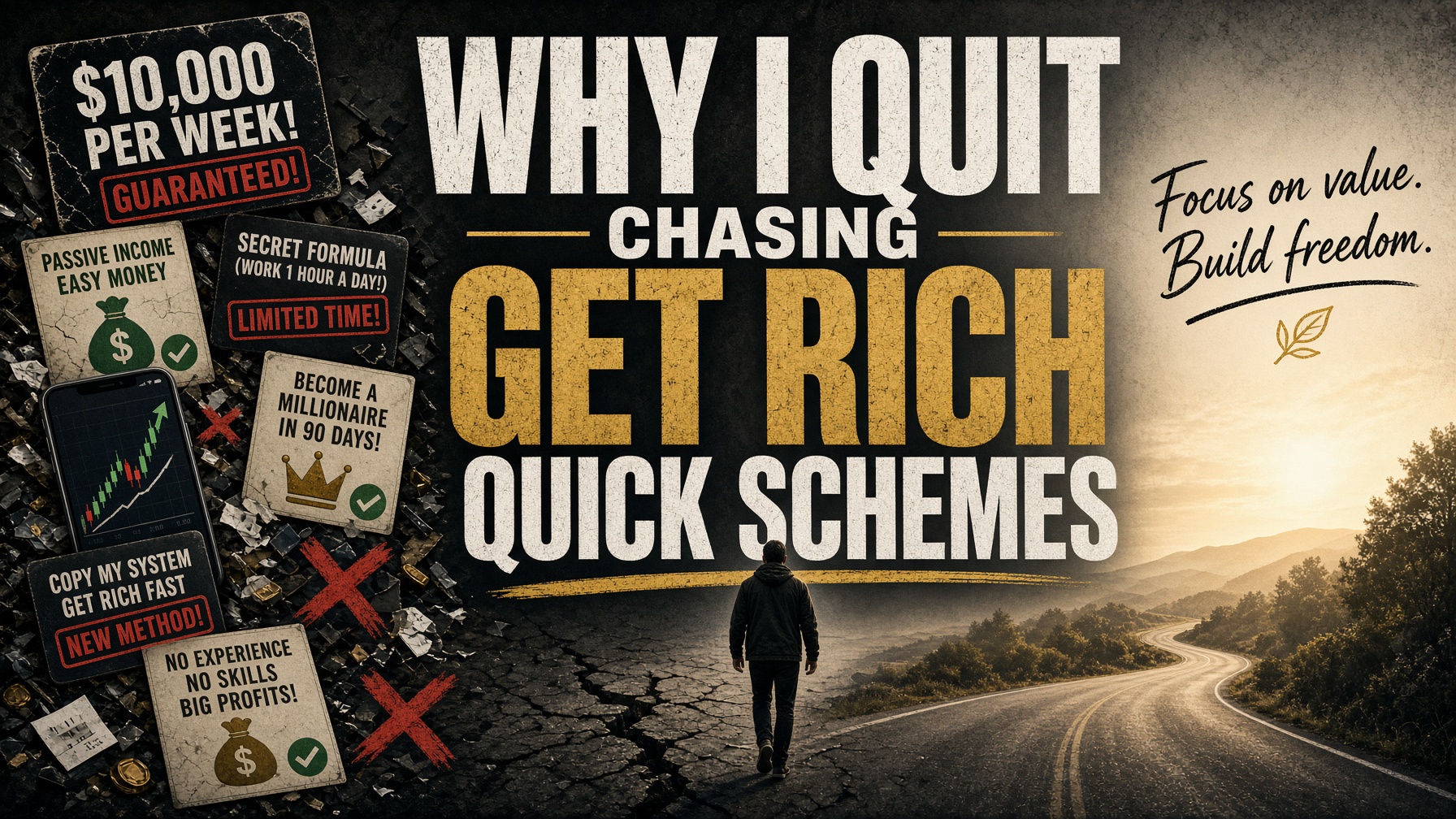
I finally realized something: I wasn’t getting rich from all those money-making programs. I was spending money trying to learn how to get rich.
Have you ever bought an online course because somebody convinced you that they had finally figured out the secret to making money?
Maybe they showed you their beautiful house, expensive car, or screenshots of thousands of dollars coming into their account.
And there you were, thinking, “Well, if they can do it, why can’t I?”
I’ve been there.
I’m an entrepreneur. I’ve always been interested in finding ways to make money and create something of my own.
But over time, I started noticing a pattern.
There was always another program, another secret method, another course, and another person claiming to have the answer.
And the more I chased those opportunities, the more I began questioning whether I was actually building a business or just becoming somebody else’s customer.
That’s why I stopped buying get-rich-quick schemes.

Watch My Video: Why I Stopped Buying Get Rich Quick Schemes
I talk about my decision to stop chasing quick-money opportunities in this video. Watch it below, then keep reading for the lessons I believe every beginner should consider before spending money on another online business program.
Watch the video directly on YouTube.
The Dream They Were Selling Me
Let’s talk about why these programs are so attractive in the first place.
Most people aren’t looking for ways to make money online because they’re bored.
They’re looking because they want something to change.
Maybe they need extra income.
Maybe they’re tired of working a traditional job.
Maybe they want more time with their family or more control over their schedule.
So when somebody tells you that you can make thousands of dollars from home, without experience, it gets your attention.
And some marketers are very good at making their opportunities look easy.
They show you the lifestyle.
They show you the earnings.
They tell you about somebody who supposedly went from struggling financially to making six figures.
But what they don’t always explain is how much money that person spent, how long it took, how many people tried and failed, or whether those results are typical.
That question changed the way I looked at online opportunities.
I Actually Bought Online Business Training
I’m not somebody who has only watched videos about these programs.
I’ve purchased online business training myself.
One example was Legendary Marketer, which I bought when it first came out.
I followed the instructions and put in the effort, but I didn’t get the results I was hoping for.
Now, I want to be fair. My experience doesn’t mean that nobody else benefited from that training.
And not making money from a course doesn’t automatically mean the course was fraudulent.
But it did teach me an important lesson.
Following somebody else’s system doesn’t guarantee that you’ll achieve the same results they advertise.
There are so many variables involved in running a business: your audience, your skills, competition, expenses, marketing, timing, and the quality of what you’re offering.
Yet some online sales pitches make the process look as simple as buying a course and following a checklist.
I learned that purchasing information and building a profitable business are two completely different things.
How the Get-Rich-Quick Cycle Keeps People Spending
Here’s how the cycle can work.
- You discover a program promising a new way to make money.
- You watch testimonials and success stories.
- You purchase the introductory training.
- You discover additional tools, coaching, or upgrades are available.
- You spend time learning the system but struggle to get results.
- You start wondering whether another program might work better.
- You buy something else and start the process again.
Before long, you’ve got a collection of courses, memberships, software subscriptions, and unfinished business ideas.
And you’re still searching for the opportunity that will finally work.
That’s the trap I wanted to get away from.
Not every course follows this pattern, and plenty of legitimate businesses sell training. The problem is when the marketing encourages unrealistic expectations or keeps customers spending without helping them understand the real work involved.
Five Lessons That Changed My Approach to Making Money Online
1. Expensive Training Doesn’t Automatically Mean Better Training
I’ve learned that a high price doesn’t guarantee valuable information.
A course might cost $2,000 while another resource teaches similar fundamentals for much less.
Before paying for training, I want to know exactly what I’m getting.
Am I paying for information, personalized coaching, software, community support, or something else?
And can I learn the basic skills somewhere else before making a large investment?
2. Income Screenshots Don’t Tell the Whole Story
Somebody showing you $20,000 in sales doesn’t tell you how much they kept.
What did they spend on advertising?
How much did they pay for software, contractors, refunds, and other expenses?
Was that one unusually successful month or their normal income?
And most importantly, how many other people tried the same system without achieving those results?
Revenue is not profit, and exceptional results are not a reliable prediction of what a beginner will earn.
3. I Needed Skills, Not Another Secret
One thing I realized is that successful online businesses usually depend on skills that aren’t very glamorous.
Researching an audience.
Writing useful content.
Understanding marketing.
Creating a product or service people actually want.
Learning how to attract customers.
Tracking expenses and results.
Those are the things I want to spend more time learning.
Because even if one business idea doesn’t work out, practical skills can still be useful in the next one.

4. I Stopped Believing Every Opportunity Was Urgent
Have you noticed how many online business offers tell you that you need to act immediately?
“Only three spots left!”
“This price disappears at midnight!”
“You’ll miss your chance if you don’t join today!”
Sometimes a legitimate business does run a limited promotion.
But when somebody is pressuring me to make a financial decision before I can research it, that’s a reason to slow down.
If I’m about to spend hundreds or thousands of dollars, I should have time to read the terms, compare alternatives, and think about whether the purchase fits my budget.
5. I Started Looking for Sustainable Progress Instead of Instant Results
I still want to make money online.
That hasn’t changed.
What changed is how I evaluate opportunities.
I’m more interested in building useful content, learning how to reach an audience, and developing something that doesn’t depend entirely on one expensive program.
I’m not expecting every project to succeed.
But I’d rather test a business idea, measure the results, and improve it than keep paying for promises of overnight success.
What the FTC Says About Online Business and Coaching Scams
These concerns aren’t just based on personal experiences.
The Federal Trade Commission warns consumers about business coaching programs that promise guaranteed earnings, unusually large returns, or easy money with little work.
Some deceptive offers begin with inexpensive training and then pressure customers into purchasing costly upgrades.
The FTC recommends researching companies, questioning testimonials, understanding the full costs, and avoiding high-pressure sales tactics.
You can read the official guidance here:
FTC: When a Business Offer or Coaching Program Is a Scam.
Seven Questions I Would Ask Before Buying Another Money-Making Program
- What exactly will I be selling, creating, or doing to earn money?
- Who are the customers, and why would they pay?
- What is the complete cost, including upgrades and subscriptions?
- Are the advertised income results typical and verifiable?
- Can I read the cancellation and refund policies before purchasing?
- Can I find independent reviews and credible customer complaints?
- Would I still consider this a worthwhile purchase if I earned no money from it?
That last question is especially important.
If the training doesn’t produce income, would the skills and information still be worth what you paid?
If the answer is no, you may want to reconsider the purchase.
Does This Mean I’ve Given Up on Affiliate Marketing?
Absolutely not.
Affiliate marketing is a legitimate business model in which companies compensate publishers or marketers for qualifying referrals.
But legitimate doesn’t mean easy, and it certainly doesn’t mean guaranteed.
There’s a difference between learning affiliate marketing and believing somebody who promises that you’ll make thousands of dollars simply by sharing links.
Successful affiliate marketing generally requires relevant traffic, useful recommendations, audience trust, and an understanding of the program’s rules.
That’s why I think beginners should start by understanding the fundamentals.
If you’re new to the subject, read my Affiliate Marketing for Beginners guide.
And before signing up for a program, read my article Read These 7 Lines of the Terms Before You Sign Up to Promote Any Affiliate Program.
What I’m Doing Differently Now
Instead of buying another course every time somebody announces a new opportunity, I’m trying to be more intentional.
I want to build websites that provide useful information.
I want to create videos that help people make informed decisions.
I want to understand how businesses earn revenue and what it costs to operate them.
And I want to make recommendations based on whether something is actually useful, not just how much commission it pays.
None of that guarantees success.
But at least I’m building knowledge and skills that I can use beyond one particular program.

What If You’ve Already Spent Money on Programs That Didn’t Work?
First, stop buying new training long enough to evaluate what you already have.
Look through your existing courses, subscriptions, and business tools.
Ask yourself whether there’s useful information you haven’t applied yet.
Then decide which expenses are worth keeping.
If a program made promises you believe were misleading, save your receipts, advertisements, contracts, and communications.
Review the refund terms and contact the seller in writing.
You can also report suspected fraud to the Federal Trade Commission.
Most importantly, don’t let the money you’ve already spent pressure you into spending even more.
Sometimes the smartest business decision is deciding not to make another purchase.
Final Thoughts: I’m Done Buying the Dream
I’m not against making money.
I’m not against entrepreneurship.
And I’m not against paying for education when it provides real value.
But I’m no longer interested in chasing every program that promises to change my financial situation overnight.
I’ve learned that the next course isn’t necessarily the answer.
Sometimes you need to stop, evaluate what you’ve already learned, and focus on building something you understand.
Because the goal isn’t to become an expert at buying online business opportunities.
The goal is to build something that has a realistic chance of working.
And that’s the direction I’m choosing now.
My Next Step: Quiet Money
If you’ve reached the point where you’re tired of chasing the next big online money-making promise, I want to share something with you.
It’s called Quiet Money.
My approach is about stepping away from the hype and focusing on practical ways to learn about building an online business.
Not overnight riches.
Not guaranteed income.
Not another promise that everything will be easy.
Just a more grounded way to explore online business opportunities and the skills behind them.
That’s the direction I’m taking, and if you’re interested, you’re welcome to explore it too.
Tired of Chasing the Next Big Thing?
Explore my Quiet Money page and learn about a different approach to building an online business—without promises of overnight success.
Explore Quiet MoneyThis page may include affiliate recommendations. I may earn commissions from qualifying purchases. No earnings or results are guaranteed.
Frequently Asked Questions
Are all get-rich-quick programs scams?
No. Some legitimate businesses can produce quick results, and some paid courses provide useful education. The warning signs are misleading earnings claims, guaranteed profits, hidden costs, and pressure to buy before researching.
Can you start an online business without an expensive course?
Yes. Many foundational skills can be learned through free or lower-cost resources. Building a business still requires effort, planning, and the ability to attract paying customers.
Is affiliate marketing still worth learning?
It can be worth learning if you’re interested in content creation, marketing, and helping people evaluate products. However, commissions are not guaranteed, and competition, traffic, and program terms affect results.
What should I do before buying an online business course?
Research the company and founder, compare independent reviews, calculate the full cost, read the refund policy, and determine exactly what skills or services you’ll receive.
What is Quiet Money?
Quiet Money is the approach I share for exploring online business opportunities with an emphasis on practical skills, realistic expectations, and avoiding exaggerated income promises. You can learn more through the Quiet Money page linked above.
Now I’d love to hear from you.
Have you ever purchased a money-making course that didn’t deliver what you expected?
What did the experience teach you?
Share your story in the comments. Your experience might help somebody else make a better decision.
Affiliate disclosure: This article contains affiliate links or links to pages that may contain affiliate offers. I may receive a commission from qualifying purchases at no additional cost to you.
Disclaimer: This article shares personal experience and general educational information. Business outcomes vary, and no income is guaranteed.