

|
Getting your Trinity Audio player ready...
|
Nobody starts affiliate marketing thinking, “I hope I spend the next six months working on something that goes nowhere.”
Most beginners start with excitement.
They’ve watched the videos. They’ve heard the success stories. They’ve discovered that people can earn commissions by recommending products online.
And they think, “Okay, I can do this.”
Then they start following advice that sounds perfectly reasonable.
Publish every day. Pick a profitable niche. Get more traffic. Let AI write your articles. Join as many affiliate programs as possible.
Before they know it, three or four months have passed, and they’re wondering why nothing is happening.
Here’s something I’ve learned: sometimes the biggest obstacle isn’t what beginners don’t know. It’s what they believe they already know.
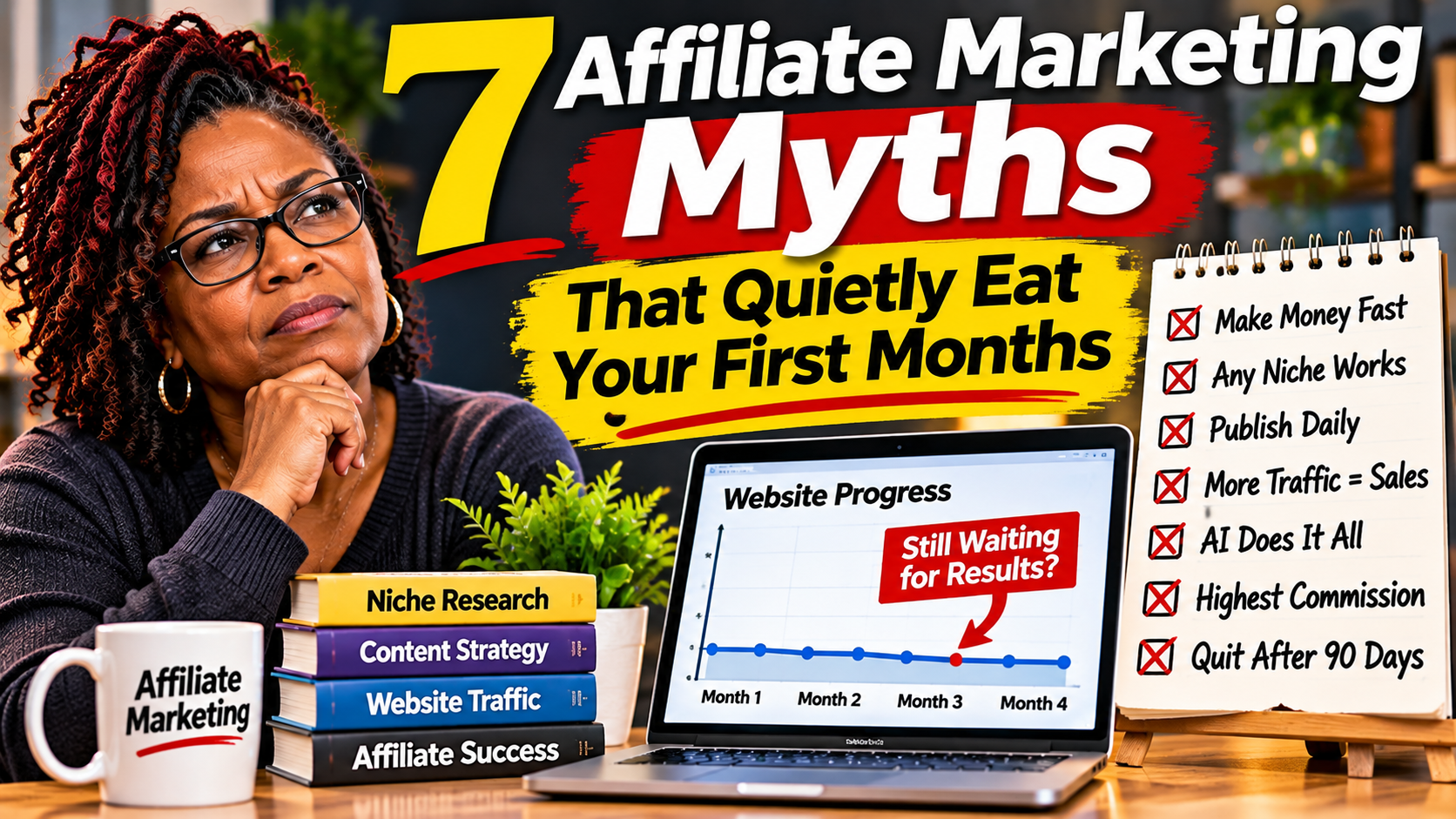
Let’s talk about seven affiliate marketing myths that can quietly eat up your first months.
Affiliate marketing is a real business model, but results are not guaranteed. These myths aren’t reasons to give up. They’re reasons to make better decisions before investing more time or money.
Myth #1: You Need to Publish Content Every Single Day
This is one of those pieces of advice that sounds productive.
If you want traffic, publish more articles. If you want more sales, publish even more.
So beginners start treating their websites like content factories.
They publish articles about anything remotely related to their niche, hoping something will eventually attract visitors.
But here’s the problem.
More content doesn’t automatically mean more useful content.
Imagine publishing 50 articles that barely answer the questions people are searching for.
Now imagine publishing 10 carefully researched articles that solve specific problems for a clearly defined audience.
The second approach may give you a stronger foundation, even though you’ve published fewer articles.
Before writing an article, ask yourself:
- Who exactly is this article helping?
- What question are they trying to answer?
- Does my article offer something genuinely useful?
- Is there a logical reason someone would trust my recommendation?
Set a publishing schedule you can maintain without sacrificing accuracy, usefulness, and originality.
Myth #2: Any Niche Can Make Money If You Work Hard Enough
I know this one might upset a few people.
We’re often told to choose something we’re passionate about and build a website around it.
And passion can help you stay interested.
But passion alone doesn’t prove there’s a business opportunity.
You might love collecting unusual coffee mugs. That doesn’t automatically mean enough people are searching for the products you want to promote or that the commissions justify the work.
On the other hand, choosing a niche simply because someone says it’s profitable can create another problem.
If you don’t understand the audience or have no interest in learning about the subject, creating genuinely helpful content may become difficult.
A good niche needs more than enthusiasm or a high commission rate.
Look for the intersection of three things:
- A specific audience with problems or needs.
- Products or services that can reasonably help.
- Topics you can research and explain with credibility.
Read my beginner’s guide to choosing an affiliate niche for a more detailed starting point.

Myth #3: Once Your Website Is Built, Google Will Find It
This one catches a lot of beginners off guard.
You spend days setting up WordPress. You choose a theme, create your pages, write your first few articles, and hit publish.
Then you wait.
And wait.
But hardly anyone visits.
Here’s what beginners need to understand: having a website online doesn’t mean people will automatically discover it.
Google needs to discover and index your pages before they can appear in its search results. Even indexed pages aren’t guaranteed to rank well.
And if your topics are highly competitive, attracting organic traffic can be especially difficult.
- Set up Google Search Console.
- Check whether your important pages are indexed.
- Make sure your website can be crawled.
- Write content that matches what people are searching for.
- Build useful internal links between related articles.
- Consider additional appropriate traffic sources instead of relying entirely on Google.
Don’t assume a lack of traffic means your website is broken. Find out what’s actually happening.
Myth #4: More Traffic Automatically Means More Affiliate Sales
Let’s say two websites each receive 1,000 visitors.
Website A attracts people looking for general entertainment.
Website B attracts people researching a specific product before buying it.
Both websites have traffic, but their visitors have very different intentions.
That’s why chasing visitor numbers without understanding your audience can waste so much time.
You could have thousands of visitors who have absolutely no interest in the products you’re recommending.
Meanwhile, a smaller website with highly relevant visitors might generate more affiliate clicks.
That doesn’t guarantee sales, but it shows why traffic quality matters.
Create content for different stages of the buying process:
- Learning: What is a credit builder loan?
- Comparing: Credit builder loan vs. secured credit card.
- Deciding: What to check before choosing a credit builder product.
When your content matches a visitor’s needs, your recommendations become more relevant.

Myth #5: AI Can Do the Entire Business for You
Now, you already know I enjoy exploring AI tools.
They can help you brainstorm, organize research, outline articles, edit drafts, and speed up repetitive tasks.
But somewhere along the way, the message changed from “AI can help you” to “AI can do everything for you.”
And that’s where beginners can get into trouble.
Imagine using AI to generate 40 articles about products you’ve never researched.
You publish them without checking the facts, verifying product information, or making sure the recommendations make sense.
You might have a website full of words, but that doesn’t mean you’ve created something people can trust.
AI can also make mistakes, invent details, and produce generic content that offers little original value.
- Use AI to assist your research, not replace verification.
- Check product claims and important facts.
- Add firsthand observations or original analysis where possible.
- Make sure every article serves a real reader.
- Review and edit before publishing.
Let AI help you work smarter, but keep yourself responsible for the quality of your business.
Myth #6: The Highest-Paying Affiliate Program Is Always the Best
Let’s say one affiliate program pays $100 per sale and another pays $15.
Which one should you choose?
Most beginners immediately say the $100 program.
But that’s not enough information to make a good decision.
What if the expensive product isn’t a good fit for your audience?
What if the program has strict promotional rules?
What if commissions are frequently reversed because customers cancel or request refunds?
Or what if the company has a poor reputation?
A high commission can look attractive on paper while being difficult to earn in practice.
Before joining an affiliate program, review:
- Whether the product genuinely fits your audience.
- Commission rates and payout requirements.
- Cookie duration and attribution rules.
- Refunds, reversals, and cancellation policies.
- Restrictions on advertising and promotions.
- The company’s reputation and customer experience.
A trustworthy product with a reasonable commission may be a better long-term choice than a questionable product with a large payout.
Myth #7: If You Haven’t Made Money in 90 Days, You’ve Failed
This might be the most discouraging myth of them all.
Some beginners believe that if they haven’t earned a commission within a few months, affiliate marketing simply doesn’t work.
Others go to the opposite extreme and believe they should keep doing the same thing indefinitely because success must be right around the corner.
Neither approach is especially useful.
The first ignores the fact that building traffic and trust can take time.
The second ignores the possibility that your strategy needs to change.
Here’s what I think beginners should focus on instead.
Don’t judge your business only by the calendar. Judge it by the evidence.
Every 30 days, review:
- Which articles are receiving search impressions?
- Are relevant visitors reaching your website?
- Are people clicking your affiliate links?
- Which topics seem to attract interest?
- What have you learned about your audience?
- Are your expenses still manageable?
If you’re not seeing progress, investigate why. Adjust your approach before deciding whether to continue.
The Bigger Problem: Beginners Spend Months Doing Things That Feel Productive
Here’s what all seven myths have in common.
They encourage activity without necessarily encouraging understanding.
You can spend weeks choosing a website theme.
You can spend months publishing articles.
You can join ten affiliate programs and experiment with every new AI tool.
And after all that work, you might still not understand who your audience is or why anyone would buy through your recommendations.
That’s why I believe beginners need to ask better questions before doing more work.
A Better First-Month Checklist
- Choose one audience. Understand the problems they want solved.
- Research one manageable niche. Look for evidence of demand and relevant products.
- Build a simple website. Focus on usability instead of endless design changes.
- Create three to five useful articles. Make each one answer a specific question.
- Learn basic analytics. Understand indexing, impressions, clicks, and referrals.
- Evaluate affiliate programs carefully. Don’t chase commission rates alone.
- Review your progress. Identify what you’ve learned and what needs improvement.
These are learning goals, not promises that you’ll earn commissions in your first month.
What I Would Do Differently If I Were Starting Today
If I were starting affiliate marketing from scratch, I wouldn’t begin by trying to build the biggest website or publish the most articles.
I’d start smaller.
One audience. One clear problem. One simple website. A handful of useful articles.
I’d spend more time understanding why someone would visit my website and less time worrying about whether I was publishing enough.
I’d use AI where it actually saved time, but I wouldn’t let it make every decision for me.
And I’d pay closer attention to my results before deciding what to do next.
If you’re completely new, start with my guide on how to build your first affiliate website.
You may also find my article on choosing your first affiliate niche helpful before you invest in hosting, tools, or training.
Want a Simpler Way to Get Started?
You don’t need another get-rich-quick promise. You need to understand what you’re building and why.
My Quiet Money beginner guide explains affiliate marketing, the tools involved, and how to approach building an online business without unrealistic expectations.
Explore Quiet Money →Frequently Asked Questions
Is affiliate marketing still worth starting?
It can be a worthwhile business model for people willing to learn content creation, marketing, and audience research. However, success is not guaranteed, and it should not be treated as dependable immediate income.
How many articles should a beginner publish?
There is no magic number. Focus on publishing accurate, helpful content that answers specific questions. Quality, relevance, and audience demand matter more than hitting an arbitrary article count.
Can beginners use AI for affiliate marketing?
Yes. AI can help with research organization, brainstorming, outlines, and editing. You should still verify facts, assess products carefully, and make sure the finished content provides genuine value.
Why am I getting traffic but no affiliate sales?
Your visitors may not be interested in buying, your recommendations may not match their needs, or the products may not be competitive. Review visitor intent, affiliate clicks, and conversion data before changing strategies.
Final Thoughts
Affiliate marketing isn’t necessarily complicated because the technology is difficult.
Sometimes it’s complicated because beginners receive so much advice that they don’t know which parts actually matter.
And the wrong advice can keep you busy for months without moving your business forward.
So before you publish another article, buy another tool, or join another affiliate program, ask yourself one question:
Is this helping me understand my audience and build a better business, or is it just keeping me busy?
That question alone could save you a lot of unnecessary work.
— Trecia, Success With Trecia
Affiliate Disclosure: Some links on this website may be affiliate links. If you purchase through one of my referral links, I may receive a commission at no additional cost to you. Affiliate marketing involves risk, and earnings are not guaranteed.