

|
Getting your Trinity Audio player ready...
|
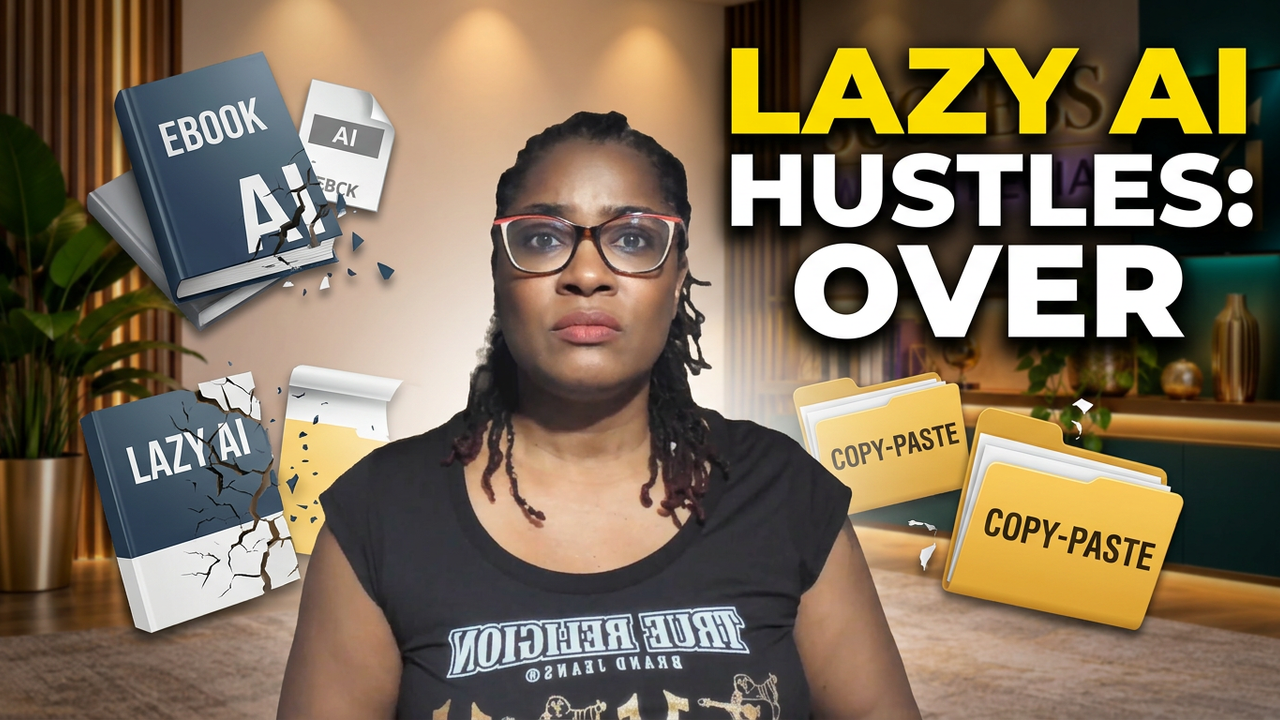
Everybody told us AI was going to make earning money online easier. So why are so many AI side hustle ideas starting to look exactly alike?
Remember when people started promoting AI-generated ebooks, faceless YouTube channels, automated blogs, and AI artwork as easy ways to earn extra money?
The pitch sounded simple: open an AI tool, type a prompt, generate something, and start selling.
But here’s the problem.
When everybody can create the same thing in five minutes, why would customers pay you a premium for it?
That’s the question more people need to be asking before starting an AI side hustle.

Watch: AI Side Hustles Are Dying
Before we get into the details, check out the video below. Then keep reading for a breakdown of which AI business models deserve a second look.
Why Are AI Side Hustles Getting Harder?
The biggest issue is low barriers to entry.
Think about it.
If one person can use an AI tool to generate 50 product descriptions, thousands of other people can use similar tools to do the same thing.
That doesn’t mean the work has no value.
It means simply knowing how to generate text or images may no longer be enough to stand out.
Customers increasingly have access to the same basic technology that sellers use.
So the real opportunity often comes from knowing how to apply AI to a specific problem.
5 AI Side Hustles That Face More Pressure
1. Mass-Produced AI Blog Posts
Some people have been promoting the idea of creating hundreds of AI-generated articles and waiting for Google traffic.
But publishing large amounts of generic content doesn’t automatically produce search rankings.
Google’s guidance explains that using generative AI to create many pages without adding value can violate its scaled content abuse policy.
The problem isn’t using AI itself.
The problem is publishing content that adds little originality or usefulness.
A better approach: Use AI to organize research, outline articles, and improve your workflow.
Then add your own expertise, examples, screenshots, demonstrations, and accurate information.
Read more in Google’s guidance on AI-generated content .
2. Generic AI Art and Digital Products
AI image generators have made it much easier to create illustrations, backgrounds, and digital designs.
That’s exciting for creators.
But if your entire business depends on selling images that buyers can easily generate themselves, you may struggle to justify your prices.
Instead of uploading hundreds of random images, consider creating products for a specific audience.
For example, a cohesive set of educational worksheets for a particular grade level could be more useful than a collection of unrelated AI graphics.
Just remember to check licensing rules, intellectual property requirements, and marketplace policies.

3. Repetitive Faceless YouTube Channels
Faceless YouTube channels aren’t automatically a bad business idea.
Plenty of creators make valuable videos without appearing on camera.
But channels built around repetitive scripts, generic narration, and mass-produced videos face challenges.
YouTube clarified its monetization guidance in 2025 to emphasize that mass-produced or repetitive content falls under its inauthentic content policy.
The important distinction is originality.
A faceless channel with original research, thoughtful storytelling, and useful commentary is different from a channel publishing nearly identical videos with minimal effort.
A better approach: Develop a recognizable point of view and create videos that provide something viewers can’t get from a generic prompt.
4. Basic AI Copywriting Services
Businesses still need persuasive emails, landing pages, product descriptions, and advertising copy.
But simply offering to generate text with AI may not be a compelling service.
A business owner can often generate a first draft independently.
What they may still need is someone who understands their customers, brand, marketing strategy, and conversion goals.
Instead of selling “AI-written emails,” consider offering a complete email campaign service with research, editing, setup, testing, and reporting.
That’s a much clearer business outcome.
5. Copy-and-Paste AI Automation
You’ve probably seen videos promising automated businesses that supposedly run themselves.
But automation doesn’t eliminate the need for customers, quality control, support, or business decisions.
If an automation produces poor results, the customer still has a problem.
The stronger opportunity is helping businesses automate specific repetitive tasks while maintaining human oversight.
So What AI Side Hustles Could Still Be Worth Exploring?
Instead of focusing on what AI can generate, think about what problems you can solve.
AI-Assisted Website Services
Help small businesses improve website content, navigation, and routine updates. Combine AI tools with real web skills.
Email Marketing Support
Assist businesses with campaign planning, email sequences, list segmentation, and performance reviews.
Content Repurposing
Turn a client’s original videos or interviews into edited clips, summaries, and social posts with permission.
Small Business Automation
Help businesses organize inquiries, schedule follow-ups, and reduce repetitive admin work.
None of these services guarantees income. You still need the skills, a clear offer, and customers willing to pay.
The Skill That Matters Most Isn’t Prompt Writing
Learning how to write better AI prompts can certainly help.
But I believe understanding your customer’s problem is even more important.
Imagine two people offering services to a local business.
The first says: “I can generate 30 AI social media posts for you.”
The second says: “I’ll review your existing content, identify common customer questions, and create a monthly content plan that addresses those questions.”
The second offer describes a process tied to the customer’s needs.
That’s the kind of thinking that can help a service stand out.

What About Affiliate Marketing?
Affiliate marketing is another area where AI can be useful without becoming the entire business.
You can use AI to help brainstorm topics, organize research, and plan content.
But your website still needs to provide helpful information that people can trust.
That might include honest product comparisons, practical tutorials, personal experience, or explanations that help readers make decisions.
If you’re just starting out, read my guide to affiliate marketing for beginners .
You can also explore my article on Wealthy Affiliate and online business training .
How to Build an AI-Assisted Business That Has a Better Chance of Lasting
- Choose a real problem. Identify something people already need help solving.
- Learn the underlying skill. Don’t depend entirely on an AI tool you don’t understand.
- Use AI to improve your process. Let it assist with drafts, organization, and repetitive tasks.
- Add human judgment. Check accuracy, improve quality, and tailor your work to the customer.
- Build proof. Create samples, demonstrations, or case studies based on actual work.
- Measure results. Find out whether customers value what you’re offering before investing heavily in more tools.
Should You Stop Trying AI Side Hustles?
No. But I would stop believing that every new AI tool is automatically a business opportunity.
Just because a tool can create something doesn’t mean people will pay for it.
And just because someone on YouTube claims they’re earning thousands of dollars with an AI side hustle doesn’t mean you’ll get the same results.
Before purchasing expensive software, ask yourself:
- Who would pay for this service?
- Why would they choose me?
- What can I offer that a basic AI prompt can’t?
- How will I find customers?
- What will the business cost to operate?
Those questions matter more than how impressive the software demonstration looks.
Want to Learn the Skills Behind an Online Business?
If you’re interested in building a website, learning content creation, and understanding digital marketing, start with the fundamentals.
AI can support those skills, but it doesn’t replace the need to understand how an online business works.
Build Skills, Not Just Prompts
Explore website-building, content creation, and digital marketing training through Wealthy Affiliate.
Explore Wealthy AffiliateAffiliate link. Training and tools do not guarantee earnings.
Frequently Asked Questions
Are AI side hustles really dying?
Not all of them. However, easily copied services may face stronger competition and pricing pressure. The viability of any business depends on demand, differentiation, costs, and execution.
Can you still make money with AI in 2026?
AI can support legitimate business services, but using AI doesn’t guarantee income. Success depends on providing something customers actually value.
Does Google penalize all AI content?
No. Google’s guidance focuses on content quality and whether material is created primarily to manipulate rankings. Mass-producing low-value content can violate its spam policies.
Can AI-generated YouTube videos be monetized?
AI use alone doesn’t automatically prevent monetization. YouTube’s rules emphasize original, authentic content and restrict mass-produced or repetitive material. Channels must meet all applicable monetization policies.
Final Thoughts: AI Isn’t the Business
AI is a tool.
A powerful one, absolutely.
But a tool isn’t the same thing as a profitable business.
The people who build sustainable businesses around AI will still need to understand their customers, deliver useful results, and adapt as technology changes.
So instead of chasing every new AI side hustle that pops up on social media, consider building skills that remain useful even when the tools change.
The easy AI money hype may be fading, but the opportunity to solve real problems hasn’t disappeared.
What do you think? Are AI side hustles becoming too crowded, or are people simply approaching them the wrong way?
Share your thoughts in the comments.
Affiliate Disclosure: This article contains affiliate links. I may earn a commission from qualifying purchases at no additional cost to you.
Editorial Note: This article discusses general market trends and business risks. It does not claim that all AI side hustles are declining or guarantee outcomes from any business model.