
|
Getting your Trinity Audio player ready...
|
So you’ve decided you want to start something online. Congratulations! Now comes the part nobody seems to explain clearly. What in the world are you supposed to do first?
Do you build a website?
Sign up for affiliate programs?
Buy a course?
Start a YouTube channel?
Or spend the next six hours watching somebody explain how they supposedly made $10,000 while sleeping?
Listen, I’ve been down that rabbit hole.
And here’s what I’ve learned.
When you’re brand-new to making money online, the biggest problem isn’t necessarily a lack of opportunities.
It’s having too many opportunities and no clear starting point.
That’s why I put together this simple seven-day plan.
We’re not going to build five businesses this week.
We’re not going to buy a bunch of software.
And we’re definitely not going to pretend you’re going to become financially independent by next Friday.
We’re going to focus on learning the basics and taking seven manageable steps toward building something useful online.
If you haven’t chosen a direction yet, start with my guide: Where to Start Online When You Know Nothing and Have No Plan.

Before We Begin: What Should You Expect After Seven Days?
Let me set some realistic expectations.
By the end of this week, you probably won’t have a profitable business.
And that’s perfectly normal.
What you should have is a better understanding of what you’re interested in building, who you want to help, and what skills you need to learn next.
You may also have your first piece of content published.
That’s progress.
And unlike a lot of those get-rich-quick promises, it’s progress you can actually measure.
Choose One Topic and Stop Looking at Everything Else
Your first assignment is simple.
Pick a subject you enjoy, understand, or genuinely want to learn more about.
That’s it.
Don’t spend the entire day trying to figure out which niche will make you a millionaire.
Think about things you naturally talk about.
Maybe you’re interested in cooking, beauty, home improvement, music, personal finance, gardening, or technology.
Now narrow that interest down.
Instead of “beauty,” maybe your topic is skincare for women over 40.
Instead of “music,” maybe it’s affordable home recording equipment for beginners.
Instead of “food,” maybe it’s budget-friendly meals for busy families.
See the difference?
You’re giving yourself a clearer audience to help.
- Write down three topics you’re interested in.
- Choose the one you could comfortably research and discuss for several months.
- Write down who might benefit from your information.
And remember, you’re not marrying this niche!
You’re choosing something to explore.
Find Out What People Actually Want to Know
Now that you have a topic, let’s find out what people are asking about it.
This is where a lot of beginners make a mistake.
They start creating content about whatever pops into their heads without checking whether anybody is interested.
Instead, I want you to do a little research.
Go to Google and type in your topic.
Look at the autocomplete suggestions.
Look at the questions people ask.
Visit YouTube and see what beginners are searching for.
You can also look at relevant forums and online communities.
Let’s say your topic is home recording.
You might discover questions like:
- What equipment do I need to record vocals at home?
- Can I record music without a soundproof room?
- What’s the difference between a USB and XLR microphone?
- How much should a beginner spend on recording equipment?
Now you’ve got real questions you can answer.
- Find ten questions people ask about your topic.
- Save them in a notebook or document.
- Choose one question that you feel comfortable researching and answering.
These questions can become your first blog posts, videos, or tutorials.
Learn What a Website Actually Is
Before you start buying website services, I want you to understand a few basic terms.
Because if you don’t know what you’re purchasing, it’s easy to spend money on things you don’t need.
Domain Name
This is your website’s address, such as YourBusinessName.com.
Web Hosting
Hosting is the service that stores your website files and makes them accessible online.
WordPress
WordPress is software you can use to build and manage a website without having to code everything yourself.
Blog Post
A blog post is an article published on your website.
SEO
Search engine optimization involves making your content and website easier for search engines to understand and potentially discover.
SEO doesn’t guarantee rankings or visitors, but it’s a useful skill to learn.
- Learn the difference between a domain and hosting.
- Watch one beginner tutorial about WordPress.
- Compare free and paid website-building options.
- Write down anything you don’t understand yet.
Don’t worry about mastering everything today.
We’re learning, not taking a final exam!

Choose Where You’re Going to Build
Now it’s time to make a decision.
Where will your content live?
If your goal is affiliate marketing through articles, a website may be a good option.
If you enjoy speaking on camera, you might prefer YouTube.
If you want to test an idea before paying for a website, you can start learning with free publishing tools.
But here’s something I personally like about having a website.
You have more control over your content and how it’s organized.
You’re not relying entirely on a social media algorithm.
That doesn’t mean a website is free from risks or guaranteed to get traffic.
It simply gives you a central place to build.
What About Wealthy Affiliate?
If you’re interested in learning website building and affiliate marketing, Wealthy Affiliate is one platform you can research.
It offers training, website tools, and a community for people learning about online business.
But I don’t recommend signing up for anything without understanding what it offers, what it costs, and whether it fits your goals.
You can read my Wealthy Affiliate review to learn more about its features, advantages, and limitations before deciding.
It’s an option, not a requirement.
- Choose one platform to learn.
- Compare its costs and limitations.
- If you’re comfortable, set up a free practice site or publishing account.
- Don’t purchase expensive upgrades just because they’re advertised.
Create Your First Piece of Helpful Content
Today is where things start getting interesting.
You’re going to create something.
Not a sales pitch.
Not an advertisement.
Something helpful.
Go back to the question you selected on Day 2.
Now write an article that answers it clearly.
For example, if your topic is home recording, your article might be:
“What Equipment Do You Actually Need to Record Vocals at Home?”
You could explain what a microphone does, why headphones matter, and which equipment beginners can wait to buy.
That’s useful information.
And useful information gives people a reason to visit your website.
Keep Your First Article Simple
- Start with the question you’re answering.
- Explain the basics in plain language.
- Break the information into short sections.
- Use examples that help beginners understand.
- Include relevant images when they add value.
- End with a helpful next step.
You don’t need to write 5,000 words.
You need to answer the question.
Write and, if you’re ready, publish your first useful article or tutorial. Focus on accuracy and clarity instead of perfection.
Learn the Difference Between Getting Traffic and Making Money
This is something I wish more beginners understood.
Just because somebody visits your website doesn’t mean they’re going to buy something.
Let’s say you write an article titled:
“What Is a Microphone?”
Someone reading that article might simply want to understand how microphones work.
Now compare that with:
“Best USB Microphones for Recording Vocals Under $150.”
That second article may attract someone who’s actively comparing products before making a purchase.
Both types of content can be valuable.
One helps people learn.
The other helps people make a buying decision.
And you can connect them with relevant internal links.
For example, your beginner microphone article could link to your product comparison for readers who are ready to explore their options.
That’s one way to build a useful website without turning every article into a sales pitch.
What About Affiliate Links?
You don’t need to sign up for ten affiliate programs during your first week.
First, understand your audience and the products that might genuinely help them.
When you’re ready, read my Affiliate Marketing for Beginners guide.
And before promoting a company, learn about its commissions, restrictions, and payment policies.
- Write down three informational article ideas.
- Write down two product comparison or review ideas.
- Think about how those articles could naturally link to one another.
Make a Realistic Plan for Your Next 30 Days
You’ve made it to Day 7!
Now don’t go celebrating by buying a $2,000 business course!
I’m kidding. Well, halfway.
Today is about deciding what you’re going to do next.
Look at what you’ve learned.
Do you still enjoy the topic you chose?
Do you understand the basics of your publishing platform?
Did you create something useful?
What confused you?
What would you like to learn next?
Use those answers to make a realistic plan.
Here’s an Example
- Week 2: Publish one or two helpful articles and learn basic website navigation.
- Week 3: Research more audience questions and improve your existing content.
- Week 4: Learn about search traffic, internal linking, and website analytics.
- Week 5: Review what you’ve created and decide what to improve next.
Adjust the schedule to fit your time and circumstances.
If you only have a few hours a week, that’s fine.
The important thing is to choose a pace you can maintain.
Write a simple 30-day plan with three measurable goals. For example: publish four useful articles, learn basic WordPress navigation, and research five potential affiliate programs without committing to any purchases.
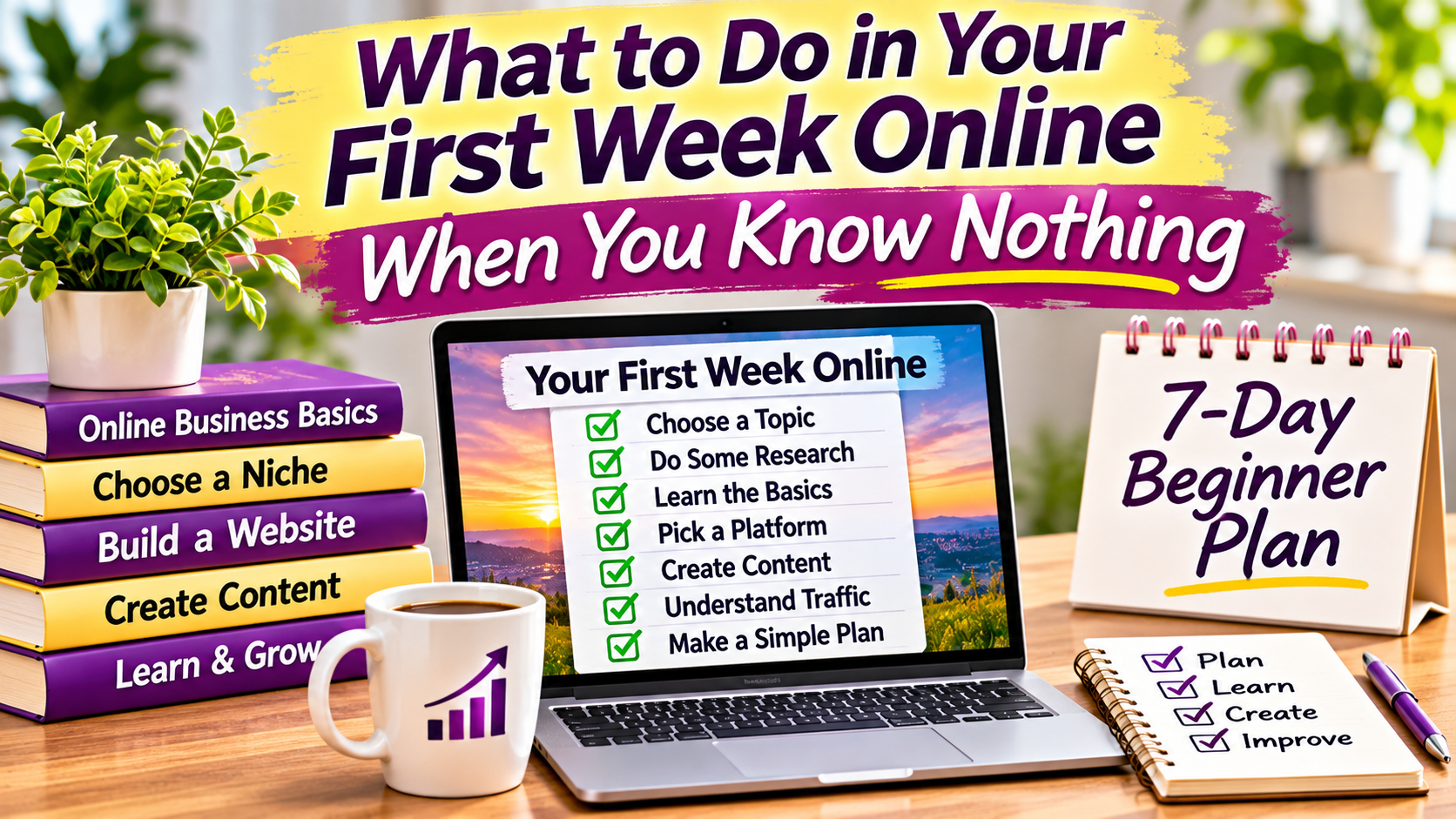
Your First-Week Checklist
Here’s a quick summary you can save and refer back to.
- Day 1: Choose one topic and identify your audience.
- Day 2: Find ten questions people ask about your topic.
- Day 3: Learn the basics of websites and online publishing.
- Day 4: Choose a platform and explore its tools.
- Day 5: Create your first helpful article or tutorial.
- Day 6: Learn about reader intent and affiliate marketing.
- Day 7: Create a realistic plan for the next 30 days.
Five Things I Would NOT Do During My First Week
Sometimes knowing what to avoid is just as important as knowing what to do.
- I wouldn’t buy an expensive course. I’d first learn what the business actually involves.
- I wouldn’t subscribe to five different tools. I’d use the minimum needed to learn.
- I wouldn’t start three businesses at once. I’d focus on understanding one idea.
- I wouldn’t expect immediate income. I’d measure learning and progress instead.
- I wouldn’t copy somebody else’s website. I’d work on developing my own useful content and perspective.

What Happens If You Don’t Finish Everything in Seven Days?
Nothing terrible!
Seriously.
There’s no rule saying you have to finish all seven steps in one week.
If learning WordPress takes you three days instead of one, take the three days.
If you need more time to choose a topic, that’s okay too.
The purpose of this plan isn’t to rush you.
It’s to give you a direction so you’re not sitting in front of your computer wondering what to do next.
And don’t compare your beginning to somebody else’s fifth year in business.
Focus on learning something you can use.
Final Thoughts: Start Small, Learn the Basics, and Keep Going
When you’re starting online with no experience, it’s easy to feel like everybody else knows something you don’t.
You see people showing off their websites, their income screenshots, and their success stories.
And you start wondering whether you’re already behind.
But everybody has to start somewhere.
You don’t need to know everything today.
You don’t need a perfect website.
You don’t need a dozen affiliate programs.
And you don’t need to spend a fortune just to learn the basics.
What you need is a starting point and the willingness to keep learning.
Seven days from now, you may not have made any money. But you could have something even more useful at this stage: a direction, a little experience, and a plan you actually understand.
Want a Simpler Approach to Getting Started?
If you’re tired of confusing online business advice and expensive get-rich-quick promises, I want to introduce you to my Quiet Money approach.
It’s about exploring practical online business opportunities, learning useful skills, and making more informed decisions about where to spend your time and money.
No guaranteed earnings.
No overnight success promises.
Just a more realistic place to begin.
Stop Chasing. Start Building.
Explore Quiet Money and learn more about taking a practical approach to starting an online business.
Explore Quiet MoneyThis page may contain affiliate recommendations. I may receive commissions from qualifying purchases. Results are not guaranteed.
Frequently Asked Questions
Can I start an online business without experience?
Yes. You can begin learning online business skills without prior experience. However, you’ll need to develop knowledge, understand your audience, and test whether your ideas are viable.
Do I need a website during my first week?
No. Your first week can focus on research and learning. A website may be useful for certain business models, but you don’t have to purchase hosting immediately.
How much money should a beginner spend?
There’s no required amount. Many fundamentals can be learned for free. Before purchasing tools or courses, understand their costs and how they fit your goals.
Should I join affiliate programs right away?
Not necessarily. It’s usually more useful to understand your audience, content strategy, and the products you might recommend before signing up for multiple programs.
Will I make money after seven days?
There’s no guarantee. The purpose of this seven-day plan is to build foundational knowledge and create a realistic starting point, not to promise immediate earnings.
Let’s Talk!
If you’re brand-new to starting an online business, tell me something in the comments.
Which day on this list do you think will be the hardest for you?
Choosing a topic?
Building a website?
Or writing that first article?
Leave your answer below. I’d love to hear where you’re starting!
Affiliate disclosure: This article contains links to resources and pages that may include affiliate offers. I may earn a commission from qualifying purchases at no additional cost to you.
Disclaimer: This article is for educational purposes only. Online business involves risk, and earnings are not guaranteed.