|
Getting your Trinity Audio player ready...
|
Why Creators Are Leaving Facebook Groups for Skool in 2026
Facebook Groups aren’t literally disappearing.
But if you’re trying to build a serious COMMUNITY instead of just collecting members…we need to talk. 😂
Okay y’all…
For YEARS, if somebody told you:
“I’m starting an online community.”
You could almost guarantee the next words were:
“I MADE A FACEBOOK GROUP!” 😂
And honestly?
Facebook Groups made sense.
Facebook already had the people.
Groups were free.
Everybody knew how to use Facebook.
You could invite people and start building a community almost immediately.
But creators are starting to ask a different question:
What If I Want More Than a Facebook Group?
What if you want your community…
AND your courses…
AND your events…
AND your paid membership…
AND your member engagement…
…inside ONE place?
That’s where platforms like Skool start becoming very interesting.
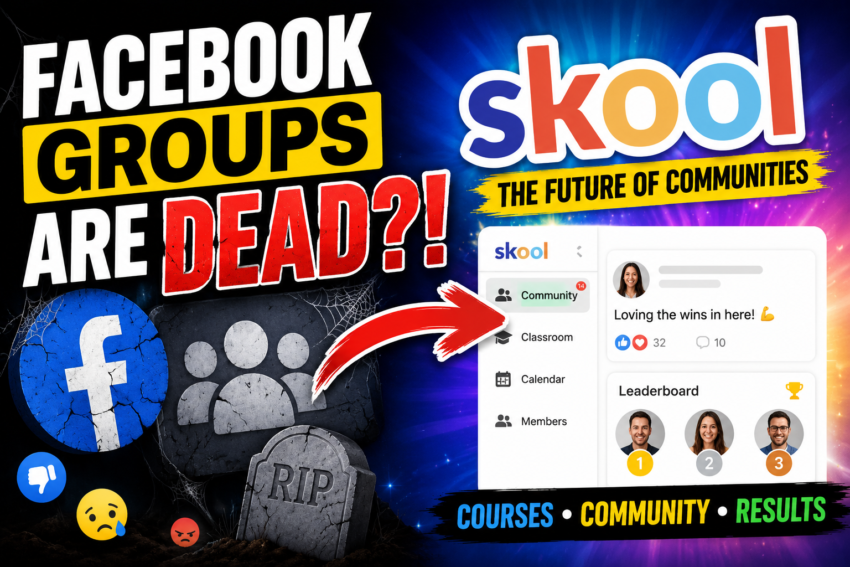
🎥 Watch: Why Creators Are Leaving Facebook Groups for Skool
I break down my thoughts in the video below. Watch it first, then keep reading because I’m going deeper into the Facebook Groups vs. Skool comparison.
🚀 Want to Look Inside Skool?
If you’re already curious about Skool, you can check it out using my link below and compare it with the way you’re currently running your community.
Affiliate disclosure: This is my affiliate link. If you sign up through it, I may earn a commission at no additional cost to you.
First: Are Facebook Groups Really Dead?
No.
Let’s clear that up right now.
Facebook Groups can still make sense if you want a free community where your audience is already spending time.
The real question isn’t:
“Is Facebook dead?”
It’s:
“Is Facebook Groups still the BEST place to build the type of community BUSINESS I want?”
Those are two completely different questions.
The Facebook Group Problem
Here’s what happens to a lot of entrepreneurs.
You start a Facebook Group.
100 people join.
Then 500.
Then 2,000.
You’re feeling GOOD.
Then you make a post…
…and 17 people see it. 😂
Now you’re wondering:
Where is everybody?
Part of the challenge is that your group lives inside a massive social network.
Your members aren’t opening Facebook specifically to visit your community.
They’re also seeing:
- Friends and family posts
- Reels
- Advertisements
- Marketplace listings
- Notifications
- Other Facebook Groups
- News and entertainment
Your community is competing with all of that attention.
Having 10,000 group members doesn’t automatically mean you have 10,000 engaged community members. Member count and active participation are two completely different things.
So What Exactly Is Skool?
Skool is a platform built specifically around online communities, courses, events and member engagement.
Instead of your community being one feature inside a giant social network, the community itself is the main attraction.
Community
Members can create posts, comment, interact and communicate inside a dedicated community feed.
Classroom
Courses and training can live inside the same environment as the community.
Calendar
Events, coaching sessions, live calls and community activities can be organized through the calendar.
Leaderboards
Members can earn points and levels based on engagement, creating a gamification system around participation.
Paid Communities
Creators can build free communities or charge for access using different membership structures.
Unlockable Content
Courses can be connected to member levels so participation can unlock additional content.
Facebook Groups vs Skool: Side-by-Side
| Feature | Facebook Groups | Skool |
|---|---|---|
| Basic Community | ✓ Yes | ✓ Yes |
| Free Community Option | ✓ Yes | ✓ Yes |
| Dedicated Classroom | Not the core Group experience | ✓ Built in |
| Courses | Requires a different setup/tool for a traditional course experience | ✓ Built in |
| Community Calendar | Events available | ✓ Built into community |
| Gamification | Limited compared with Skool | ✓ Points + Levels + Leaderboards |
| Level-Locked Courses | ✗ Not a standard Group feature | ✓ Yes |
| Paid Memberships | Not the primary Groups model | ✓ Built around community pricing |
| Freemium Community | Not built around this model | ✓ Available |
| Member Affiliate Program | Requires outside setup | ✓ Available on qualifying Skool plan |
The Part About Skool I Find Most Interesting
It’s not actually the course hosting.
It’s not the calendar.
And it’s not even the paid memberships.
It’s the GAMIFICATION.
Here’s how it works.
When members participate and other members like their posts, comments or replies, they earn points.
Those points move them through different levels.
And the community has a leaderboard.
Think About What That Changes
Instead of asking people:
“PLEASE ENGAGE IN MY GROUP!”
you’re giving them a reason to participate.
POST → HELP PEOPLE → EARN LIKES → EARN POINTS → LEVEL UP → UNLOCK CONTENT
You Can Even Unlock Courses Through Engagement
This is where Skool gets clever.
A community owner can make certain courses available only after a member reaches a particular level.
So instead of dumping every resource on somebody the second they join…
you can reward participation.
Example
Level 1: Welcome Course
Level 2: Beginner Training
Level 3: Templates
Level 4: Advanced Workshop
Level 5: Special Bonus Training
That’s a completely different community dynamic from simply posting something into a Facebook feed and hoping members see it.
Then There’s Monetization 💰
This is another reason creators may consider moving beyond a traditional Facebook Group.
Skool currently supports several ways to structure access to a community.
🆓 Free
Allow people to join the community without paying.
💳 Subscription
Charge members monthly or annually for access.
🆓 + 💰 Freemium
Offer both free and paid membership levels inside the same community.
📊 Tiers
Create multiple paid plans with different benefits.
💵 One-Time Payment
Charge once for access instead of using recurring billing.
🤝 Affiliates
On eligible plans, community members can be given affiliate commissions for referring new members.
This Is Where Skool Gets Interesting
Imagine starting with a free community.
People join.
They learn from your free content.
They interact with you.
They get results.
And then the people who want more can upgrade into your premium offer.
Community and monetization can live inside the same ecosystem.
START YOUR SKOOL COMMUNITY →Affiliate disclosure: I may earn a commission if you sign up through my link at no additional cost to you.
How Much Does Skool Cost in 2026?
At the time this article was updated, Skool offers two primary community plans.
Hobby — $9/month
The Hobby plan includes unlimited members, courses, videos and live calls.
The important number to notice is the transaction fee: 10%.
Pro — $99/month
Pro also includes unlimited members, courses, videos and live calls.
Its transaction fee is currently 2.9%.
Don’t automatically assume the $9 plan is cheaper.
If you’re running a paid community and your revenue grows, the difference between a 10% and 2.9% transaction fee can become important.
Do the math based on YOUR expected membership revenue before choosing a plan.
Why I Wouldn’t Automatically Delete Your Facebook Group
Now hold on.
Before somebody leaves this article and starts deleting Facebook Groups… 😂
That is NOT what I’m telling you to do.
Facebook still has something incredibly valuable:
PEOPLE.
Your audience may already be there.
So instead of thinking:
FACEBOOK OR SKOOL
you could potentially think:
A Smarter Funnel
SOCIAL MEDIA → FREE CONTENT → SKOOL COMMUNITY → RELATIONSHIP → PREMIUM OFFER
Facebook can help people discover you while your dedicated community becomes the place where deeper engagement happens.
Who Should Consider Skool?
- Coaches
- Consultants
- Course creators
- YouTubers
- Affiliate marketers
- Online educators
- Membership business owners
- Fitness instructors
- Business mentors
- Creators with an existing audience
- Anyone wanting community + courses in one place
- Entrepreneurs interested in recurring membership revenue
Who Might Be Better Off With Facebook Groups?
Skool isn’t automatically better for everybody.
Facebook Groups can still be a good fit if:
- You want a completely free basic group.
- Your audience already spends significant time on Facebook.
- You don’t need courses.
- You don’t need gamification.
- You aren’t planning to charge for community access.
- You don’t want another platform to manage.
- Your Facebook community is already active and working well.
Trecia’s Rule
Don’t move platforms because something is trendy. Move because the new platform solves a problem your current platform doesn’t.
What I Like About Skool
👍 Simple Layout
Community, classroom, calendar and leaderboards are organized around a fairly focused experience.
👍 Built-In Courses
You don’t necessarily need a completely separate platform just to organize community training.
👍 Gamification
Points, levels and leaderboards create incentives for members to participate.
👍 Monetization
Free, subscription, freemium, tiered and one-time pricing give creators multiple business models to consider.
What I Don’t Like
👎 Facebook Is Free
For a creator who only needs a simple free discussion group, Facebook has an obvious price advantage.
👎 You’re Moving Your Audience
People already know Facebook. Asking them to join another platform creates an additional step.
👎 Transaction Fees Matter
If you’re charging members, you need to calculate the transaction fees instead of looking only at the monthly subscription.
👎 It Doesn’t Replace Everything
Depending on your business, you may still need other tools for email marketing, advanced automation, websites or specialized business functions.
My Verdict: Skool vs Facebook Groups in 2026
I don’t think Facebook Groups are literally dead.
But I DO think creators now have better choices depending on what they’re trying to build.
If your goal is:
“Give people somewhere free to talk.”
Facebook may be perfectly fine.
But if your goal is:
COMMUNITY
+
COURSES
+
EVENTS
+
GAMIFICATION
+
PAID MEMBERSHIPS
Then Skool becomes a much more interesting comparison.
Want to Try Skool for Yourself?
Don’t switch because I told you to.
Go look at the platform.
Think about the type of community you’re trying to build.
Compare it with what you’re doing now.
Then decide whether Skool makes sense for YOUR business.
CHECK OUT SKOOL →This is an affiliate link. I may earn a commission from qualifying sign-ups at no additional cost to you.
Frequently Asked Questions
Is Skool better than Facebook Groups?
It depends on what you’re building. Facebook Groups can work well for free communities inside an existing social network. Skool is more purpose-built for creators who want community, courses, gamification, events and monetization together.
How much does Skool cost in 2026?
At the time this article was updated, Skool lists Hobby at $9 per month with a 10% transaction fee and Pro at $99 per month with a 2.9% transaction fee. Pricing can change, so verify the current offer before subscribing.
Can you create a free Skool community?
Yes. Skool supports free groups as well as subscription, freemium, tiered and one-time-payment models.
Can I sell courses on Skool?
Skool includes Classroom functionality for courses. Courses can also use different access methods, including level-based access that rewards community participation.
How does Skool gamification work?
Members can earn points when other members like their posts, comments and replies. Accumulated points create levels, and communities can use leaderboards and level-based course unlocks.
Should I delete my Facebook Group and move to Skool?
Not necessarily. If your Facebook Group is active and accomplishing your goals, there may be no reason to abandon it. Some creators may instead use social platforms for discovery while using a dedicated community platform for deeper engagement or paid membership.
Can I charge people to join my Skool community?
Yes. Skool supports subscription communities as well as freemium, tiered and one-time-payment pricing structures.
Final Thoughts
Here’s the biggest shift I see.
For years, entrepreneurs thought:
“I NEED A FACEBOOK GROUP.”
Now I think the better question is:
“WHAT KIND OF COMMUNITY AM I ACTUALLY TRYING TO BUILD?”
Because a Facebook Group…
a free Skool community…
a paid membership…
and an online course business…
are not necessarily trying to accomplish the same thing.
Choose the platform based on the BUSINESS you’re building—not because everybody else is using it.
Build Your Community
If you’ve been thinking about creating your own online community, take a look at Skool and decide whether its community + classroom + gamification approach fits your idea.
EXPLORE SKOOL →This article is for educational and informational purposes only. Platform features, pricing, transaction fees, trials and policies can change. Always verify current terms before subscribing or moving an existing community. This article contains affiliate links. If you sign up through one of my affiliate links, I may receive compensation at no additional cost to you. No platform guarantees community growth, engagement, revenue or business results.